Which type of chart is not appropriate for displaying the relationship between two categorical variables?
A scatterplot is not appropriate for displaying the relationship between two categorical variables, as it is used for quantitative variables. Contingency tables are the standard tool for showing relationships between categorical variables.
What types of questions can be answered using a two-way (contingency) table?
A two-way (contingency) table can answer questions about the frequency or count of observations that fall into combinations of categories for two categorical variables, such as 'How many students are in a particular grade and height category?' or 'What is the total number of students in a specific category across both variables?'
How do you find the observed frequency for a specific combination of categories in a contingency table?
You locate the intersection of the relevant row and column in the table. The number at that intersection is the observed frequency for that combination.
What does the row total in a contingency table represent?
The row total represents the sum of observed frequencies for all categories in that row. It shows the total count for one variable across all levels of the other variable.
How do you calculate the expected frequency for a cell in a contingency table assuming independence?
Multiply the row total by the column total and divide by the grand total. This gives the expected frequency for that cell under the assumption of independence.
What is the formula for expected frequency in a contingency table?
Expected frequency equals (row total × column total) divided by the total sample size. This formula assumes the two variables are independent.
Why might observed and expected frequencies differ in a contingency table?
Observed frequencies are based on actual data, while expected frequencies are calculated under the assumption of independence. Differences may indicate a relationship between the variables.
What is a joint probability in the context of contingency tables?
Joint probability is the probability of two events occurring together, such as being in a specific grade and height category. It is calculated by multiplying the probabilities of each event if they are independent.
What does the grand total in a contingency table refer to?
The grand total is the sum of all observed frequencies in the table. It represents the total number of observations in the dataset.
How can subtotals in a contingency table help with calculations?
Subtotals provide the sums for rows and columns, making it easier to calculate expected frequencies and answer questions about totals. They save time by eliminating the need to add individual cell values manually.
 Back
Back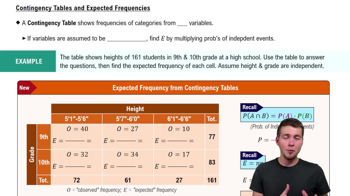
 08:18
08:18