Correlation Coefficient quiz #2 Flashcards

Correlation Coefficient quiz #2
Control buttons has been changed to "navigation" mode.
1/40
  • Which is not an example of correlation analysis?
    Analyzing causation is not an example of correlation analysis.
  • What does a scatterplot look like for data with a Pearson correlation of r = +0.88?
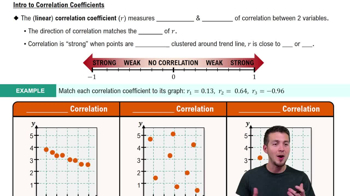
    The data points are tightly clustered around an upward-sloping line, indicating a strong positive correlation.
  • What is the goal of correlation analysis?
    The goal is to measure the strength and direction of the linear relationship between two variables.
  • What is the possible range of values for the multiple correlation coefficient r?
    The multiple correlation coefficient r ranges from 0 to 1.
  • What are all the possible values that a correlation coefficient r can take?
    r can take any value between -1 and 1, inclusive.
  • Which correlation coefficient represents the strongest relationship?
    The r-value closest to ±1 represents the strongest relationship.
  • What is the coefficient of determination for a linear model?
    The coefficient of determination is r squared (r²), representing the proportion of variance explained by the model.
  • How is the correlation between variable x and variable y represented?
    It is represented by the correlation coefficient r.
  • How do you determine which pair of variables in a dataset has the strongest correlation?
    The pair with the r-value closest to ±1 has the strongest correlation.
  • If the coefficient of determination is 0.60, what does this mean?
    It means that 60% of the variance in the dependent variable is explained by the independent variable.
  • Which value represents a weak positive correlation?
    An r-value close to 0 but positive, such as 0.19, represents a weak positive correlation.
  • If the correlation between x and y is -1.0, what does this indicate?
    It indicates a perfect negative linear relationship.
  • Which value of r indicates a stronger correlation: a value closer to ±1 or closer to 0?
    A value closer to ±1 indicates a stronger correlation.
  • What does a plot with a correlation of 0.7 look like?
    The data points are moderately clustered around a line, indicating a moderate positive correlation.
  • What is not measured or described by a correlation coefficient?
    Correlation does not measure causation or non-linear relationships.
  • Which value of r indicates a stronger correlation than 0.40?
    Any r-value with a greater absolute value than 0.40, such as 0.56 or -0.75, indicates a stronger correlation.
  • Which value of r indicates a stronger correlation than +0.40?
    Any r-value greater than +0.40, such as +0.56 or +0.83, indicates a stronger correlation.
  • Which value of r indicates the strongest correlation?
    The r-value closest to ±1 indicates the strongest correlation.
  • Which statements about correlation are true?
    Correlation measures linear association, ranges from -1 to 1, and does not imply causation.
  • What are the characteristics of the correlation coefficient r?
    It is unitless, ranges from -1 to 1, and measures strength and direction of linear association.
  • If r = 0.65, how would you describe the correlation?
    There is a moderate positive linear correlation.
  • What does the degree of strength of the linear relationship between x and y refer to?
    It refers to the magnitude of the correlation coefficient r.
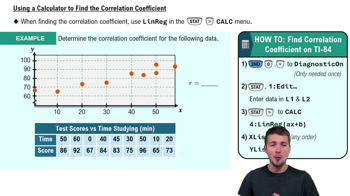
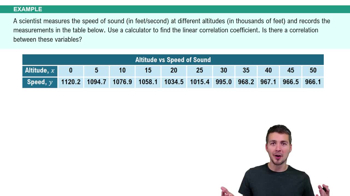
  • When using the correlation function on a calculator, what does the output r represent?
    The output r represents the linear correlation coefficient between the two variables.
  • Which r-value represents the strongest negative correlation: -0.7, -0.22, 0.38, or 0.9?
    -0.7 represents the strongest negative correlation.
  • Which r-value represents the strongest correlation: -0.83, -0.67, 0.48, or 0.79?
    -0.83 and 0.79 are both strong, but -0.83 is stronger in magnitude.
  • Which r-value is most likely for a dataset with a strong positive linear relationship: -0.91, -0.35, 0.35, or 0.91?
    0.91 is most likely for a strong positive linear relationship.
  • Which r-value is most likely for a dataset with a strong positive linear relationship: -0.83, -0.21, 0.21, or 0.83?
    0.83 is most likely for a strong positive linear relationship.
  • Which r-value represents the strongest negative correlation: -0.7, -0.22, 0.38, or 0.9?
    -0.7 represents the strongest negative correlation.
  • For which scatterplot is the correlation between x and y closest to 0?
    The scatterplot with data points widely scattered and no apparent trend has a correlation closest to 0.
  • What is true about correlation and causation?
    Correlation does not imply causation; it only measures association.
  • What word best describes the degree of overlap between two data sets with a high correlation coefficient?
    The word 'association' best describes the degree of overlap.
  • Which of these is not a possible r-value?
    Any value outside the range -1 to 1 is not a possible r-value.
  • What does a scatterplot suggesting a linear relationship look like?
    The data points are clustered around a straight line.
  • What is a measure of how well the regression fits the sample data?
    The coefficient of determination (r²) measures how well the regression fits the data.
  • What does a scatterplot with a trend line with a negative slope indicate?
    It indicates a negative correlation between the variables.
  • How would you describe the strength of a model with an r-value of -0.93?
    It is a very strong negative linear correlation.
  • Which correlation coefficient represents a moderate negative correlation?
    An r-value around -0.5, such as -0.56, represents a moderate negative correlation.
  • Which is not one of the three common errors involving correlation?
    Assuming correlation implies causation is a common error; not considering non-linear relationships is another.
  • Which value of r indicates a stronger correlation: a value closer to ±1 or closer to 0?
    A value closer to ±1 indicates a stronger correlation.
  • Which value could not represent a correlation coefficient?
    Any value less than -1 or greater than 1 cannot represent a correlation coefficient.