Describing Data Numerically Using a Graphing Calculator quiz #1 Flashcards

Describing Data Numerically Using a Graphing Calculator quiz #1
Control buttons has been changed to "navigation" mode.
1/22
  • What does it mean for a distribution to be left skewed?
    A left skewed distribution, also known as negatively skewed, has a longer tail on the left side, meaning most data values are concentrated on the right with a few lower values stretching the distribution to the left.
  • Which type of data can be measured quantitatively?
    Quantitative data can be measured numerically and includes variables such as height, weight, age, and test scores.
  • How do you determine the number of values within a specific range in a data set using a graphing calculator?
    To determine the number of values within a specific range, input the data into the calculator, sort or review the list, and count the values that fall within the desired range.
  • What is the correct term for a pattern of variation observed in a data set?
    The correct term for a pattern of variation in a data set is 'distribution.'
  • What is the difference between univariate data and bivariate data?
    Univariate data involves one variable and is used to describe a single characteristic, while bivariate data involves two variables and is used to explore relationships between them.
  • What type of quantitative data results from measuring rather than counting?
    Continuous data results from measuring and can take any value within a range, such as height or weight.
  • What is the name for a tool that groups and summarizes data in a concise format of rows and columns?
    A frequency table is a tool that groups and summarizes data in rows and columns.
  • Heights of trees are an example of which type of data?
    Heights of trees are an example of continuous quantitative data.
  • Which of the following is not an example of discrete data: number of students, number of cars, height of a person, or number of books?
    Height of a person is not an example of discrete data; it is continuous data.
  • What can be used to compare two or more data sets to identify patterns and trends?
    Descriptive statistics, such as mean, median, and standard deviation, can be used to compare data sets and identify patterns and trends.
  • What describes the process of turning data points into useful information?
    Data analysis is the process of turning data points into useful information.
  • What is an important consideration when interpreting data using descriptive statistics?
    When interpreting data, it is important to consider measures of central tendency and variability to accurately describe the data set.
  • How can you use summary statistics to make generalizations about a data set?
    You can use summary statistics such as the mean, median, and quartiles to make generalizations about the central tendency and spread of a data set.
  • What does the cardinality of a data set refer to?
    The cardinality of a data set refers to the number of elements or data points in the set.
  • If Jason is collecting data on the number of books students read each year, what type of data is he collecting?
    Jason is collecting discrete quantitative data.
  • Amounts of yearly rainfall in a city over the last 5 years are an example of which type of data?
    Amounts of yearly rainfall are examples of continuous quantitative data.
  • What is the best way to describe participants' data from published results?
    Participants' data from published results are typically summarized using descriptive statistics such as mean, median, and standard deviation.
  • For what purposes are descriptive statistics generally used?
    Descriptive statistics are generally used to summarize, organize, and describe the main features of a data set.
  • What steps should you follow to analyze a data set using a TI-84 calculator?
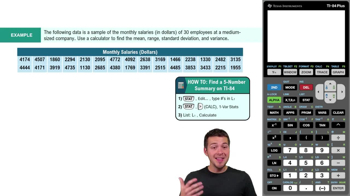
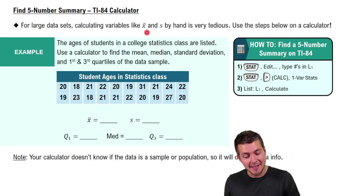
    To analyze a data set, input the data into a list, use the 1-variable stats function, and interpret the output, which includes the mean, standard deviation, and five-number summary.
  • What is a piece of data expressed in numbers and percentages called?
    A piece of data expressed in numbers and percentages is called quantitative data or a quantitative statistic.
  • What is the process of expressing observed data as a number called?
    The process of expressing observed data as a number is called quantification.
  • What is the process of extracting portions of a data set that are relevant to the analysis called?
    The process of extracting relevant portions of a data set is called data selection or data filtering.