Which type of variable, in the context of data about a track team, would be considered a discrete variable?
A discrete variable for a track team could be the number of races won, the number of team members, or the number of medals earned, as these are countable and have distinct values.
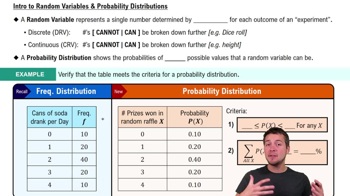
What are the two requirements for a discrete probability distribution?
The two requirements are: (1) Each probability must be between 0 and 1, inclusive; (2) The sum of all probabilities for all possible outcomes must equal 1.
Which types of phenomena can be represented by a discrete random variable?
Discrete random variables represent phenomena with countable outcomes, such as the number of heads in coin tosses, the number of students in a class, or the number of cars passing through an intersection.
How can you distinguish between discrete and continuous random variables?
Discrete random variables have countable, distinct outcomes (e.g., number of dice rolls), while continuous random variables can take any value within a range (e.g., height or weight).
What is an example of a discrete random variable?
An example of a discrete random variable is the number of children in a household.
What are the criteria for a binomial probability experiment?
The criteria are: (1) The experiment consists of a fixed number of trials; (2) Each trial has two possible outcomes (success or failure); (3) The probability of success is the same for each trial; (4) The trials are independent.
Which type of variable is not continuous?
A variable that is not continuous is a discrete variable, such as the number of books on a shelf.
What type of variable is the number of auto accidents reported in a given month?
The number of auto accidents reported in a given month is a discrete random variable, as it represents a countable number of events.
What is an example of a discrete variable?
An example of a discrete variable is the number of students present in a classroom.
Which type of variable is not a discrete random variable?
A variable that is not a discrete random variable is a continuous variable, such as the exact time a runner finishes a race.
What is a discrete random variable?
A discrete random variable is a variable that can take on a finite or countable number of distinct values, such as the number of heads in coin tosses.
What is a binomial random variable?
A binomial random variable counts the number of successes in a fixed number of independent trials, each with the same probability of success.
How can you identify discrete variables in a dataset?
Discrete variables are those that have countable, distinct values, such as the number of pets owned or the number of cars in a parking lot.
What are the criteria for a binomial probability experiment?
The criteria are: (1) Fixed number of trials; (2) Each trial has two possible outcomes; (3) Probability of success is constant; (4) Trials are independent.
A _______ random variable has either a finite or a countable number of values. Fill in the blank.
Discrete
What are the criteria for a binomial probability experiment?
The criteria are: (1) Fixed number of trials; (2) Each trial has two possible outcomes; (3) Probability of success is constant; (4) Trials are independent.
Every discrete random variable is associated with a probability distribution. What does this distribution represent?
A probability distribution for a discrete random variable represents the probabilities of all possible outcomes of the variable.
If a random variable x is uniformly distributed between 10 and 20, what type of random variable is x?
x is a continuous random variable, as it can take any value within the interval from 10 to 20.
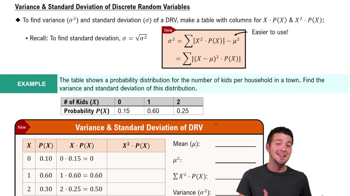
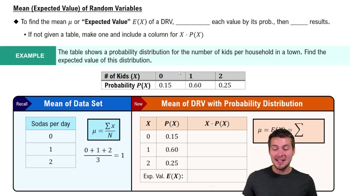
Given a table that provides a probability distribution for a random variable y, how would you find the mean of y?
To find the mean of y, multiply each possible value of y by its probability, then sum these products: mean = Σ[y × P(y)].
What are the two requirements for a discrete probability distribution?
The two requirements for a discrete probability distribution are: (1) Each probability must be a number between 0 and 1, inclusive; and (2) The sum of all probabilities for all possible outcomes must equal 1.
 Back
Back

 04:14
04:14