Dot Plots quiz #1 Flashcards

Dot Plots quiz #1
Control buttons has been changed to "navigation" mode.
1/10
  • What are the key features of a dot plot for displaying quantitative data?
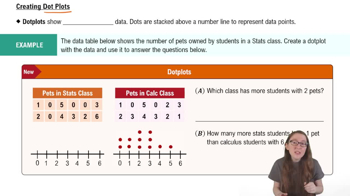
    Key features of a dot plot include: (1) it displays quantitative (numerical) data, (2) it uses a number line as the horizontal axis, (3) each data point is represented by a dot placed above its corresponding value on the number line, (4) repeated values are shown by stacking dots vertically, and (5) it allows for quick identification of trends and specific values in the dataset.
  • How does a dot plot differ from a histogram in terms of the information it displays?
    A dot plot shows the specific values in the dataset, while a histogram groups data into bins. This allows dot plots to display individual data points and repeated values more clearly.
  • What is the first step in creating a dot plot from a dataset?
    The first step is to draw a number line that covers the range of values in your dataset. This number line serves as the horizontal axis for placing dots.
  • How are repeated values represented in a dot plot?
    Repeated values are shown by stacking dots vertically above the corresponding value on the number line. Each dot represents one occurrence of that value.
  • What should you do after placing a dot for a data point when constructing a dot plot?
    You should cross off the data point to avoid accidentally adding an extra dot for the same value. This helps ensure accuracy in your dot plot.
  • How can you use a dot plot to compare the number of students with a specific number of pets in two classes?
    Count the number of dots above the relevant value in each class's dot plot. The class with more dots above that value has more students with that number of pets.
  • What does the vertical stacking of dots above a number in a dot plot indicate?
    Vertical stacking indicates that multiple data points share the same value. The height of the stack shows the frequency of that value in the dataset.
  • If a value on the number line has no dots above it in a dot plot, what does this mean?
    It means that no data points in the dataset have that value. The absence of dots indicates zero frequency for that value.
  • How can you determine the difference in frequency between two values using a dot plot?
    Count the dots above each value and subtract the smaller count from the larger. The result gives the difference in frequency between the two values.
  • Why is crossing off data points important when constructing a dot plot by hand?
    Crossing off data points helps prevent errors such as double-counting. It ensures each data point is represented by exactly one dot in the plot.