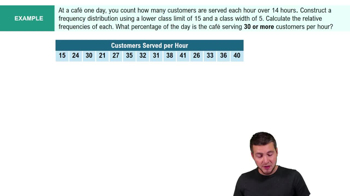
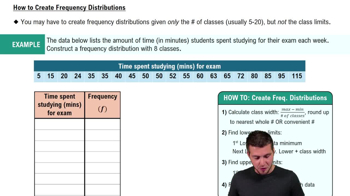
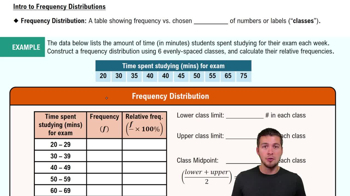
A relative frequency distribution expresses the frequency of each class as a percentage or proportion of the total number of observations.
How do you calculate the relative frequency for a class in a frequency distribution?
Divide the frequency of the class by the total number of observations and multiply by 100 to get a percentage.
Which operation is performed to obtain a relative frequency distribution from a frequency distribution?
Each class frequency is divided by the total number of observations to obtain the relative frequency.
What is a frequency distribution and what does it represent?
A frequency distribution is a table that organizes data into classes and shows the number of measurements (frequency) in each class.
What are some characteristics of a skewed data set as seen in a frequency table?
A skewed data set in a frequency table will have frequencies that are not symmetric, with more data concentrated on one side of the distribution.
What are the main characteristics of frequency distributions?
Frequency distributions organize data into classes, show the frequency of each class, and help visualize the distribution of data.
What information does a relative frequency distribution provide?
It provides the proportion or percentage of observations that fall within each class.
What is the difference between relative frequency and cumulative frequency?
Relative frequency is the proportion or percentage of observations in a class, while cumulative frequency is the sum of frequencies for that class and all previous classes.
How do class limits differ from class boundaries in a frequency distribution?
Class limits are the lowest and highest values that can belong to a class, while class boundaries are the values that separate classes without gaps.
How is a frequency distribution for qualitative data best described?
It is a table that lists categories (labels) and the frequency of observations in each category.
What is the purpose of organizing data into a frequency table or frequency distribution?
It helps to summarize and organize data, making it easier to analyze and visualize patterns.
What are some characteristics of frequency tables?
Frequency tables display classes or categories and the corresponding frequencies of data within each class.
How does a frequency polygon differ from an ogive?
A frequency polygon is a line graph of class midpoints versus frequencies, while an ogive is a line graph of class boundaries versus cumulative frequencies.
What are some benefits of representing data sets using frequency distributions?
They organize data, reveal patterns, make large data sets easier to interpret, and facilitate the creation of graphs.
Why is it recommended to use between 5 and 20 classes in a frequency distribution?
Using 5 to 20 classes provides enough detail to reveal patterns without making the distribution too complex or too simplistic.
What are some benefits of using graphs of frequency distributions?
Graphs make it easier to visualize data patterns, compare distributions, and identify trends or outliers.
What are some indicators of a skewed data set in a frequency table?
A skewed data set will have frequencies that are higher on one side and taper off on the other, indicating asymmetry.
What types of data can be represented as frequency tables?
Both qualitative (categorical) and quantitative (numerical) data can be represented as frequency tables.
How do you construct a frequency distribution for a set of quiz scores?
Divide the range of scores into classes, count the number of scores in each class, and list the frequencies in a table.
Which criterion is least important when choosing the number of bins (classes) in a frequency distribution?
The specific values of the data are less important than ensuring the number of classes is appropriate (typically 5 to 20) and that classes are of equal width.
How do you calculate the relative frequency for a specific class?
Divide the frequency of the class by the total number of observations.
What type of graph is used to display cumulative frequency?
An ogive is used to display cumulative frequency.
How do you construct a relative frequency table for a categorical variable such as eye color?
List each eye color category, count the frequency for each, divide by the total number of observations, and express as a proportion or percentage.
How does cumulative frequency differ from relative frequency?
Cumulative frequency is the running total of frequencies up to a certain class, while relative frequency is the proportion of observations in a single class.
What are the possible shapes of a frequency distribution?
A frequency distribution can be symmetric, skewed left, skewed right, or uniform.
What are the advantages of using frequency distributions to represent data sets?
They simplify large data sets, reveal patterns, and make it easier to analyze and visualize data.
Why is it important to limit the number of classes in a frequency distribution to between 5 and 20?
Too few classes oversimplify the data, while too many classes make the distribution difficult to interpret.
How do you determine which interval accounts for the lowest percentage of response times in a frequency distribution?
Identify the class with the lowest frequency, calculate its relative frequency, and compare to other classes.
How is class width calculated in a frequency distribution?
Class width is calculated by subtracting the minimum value from the maximum value and dividing by the number of classes, then rounding up if necessary.
What is the distinction between relative frequency and cumulative frequency?
Relative frequency is the proportion of observations in a class, while cumulative frequency is the total number of observations up to and including that class.
How do class limits differ from class boundaries?
Class limits are the smallest and largest data values that can belong to a class, while class boundaries are the values that separate classes without gaps.
What are the main benefits of using frequency distributions to represent data sets?
They organize data, make patterns visible, and facilitate further analysis and graphing.
Why should the number of classes in a frequency distribution typically be between 5 and 20?
This range balances detail and clarity, making the distribution informative but not overwhelming.
What are the advantages of using graphs to represent frequency distributions?
Graphs provide a visual summary of data, making it easier to identify trends, patterns, and outliers.
Which type of frequency distribution graph is appropriate for data measured on a nominal scale?
A bar graph is appropriate for nominal data.
What does a relative frequency distribution show?
It shows the proportion or percentage of observations in each class relative to the total number of observations.
What are the possible shapes of a frequency distribution?
Possible shapes include symmetric, skewed left, skewed right, and uniform.
How is a relative frequency distribution constructed?
By dividing each class frequency by the total number of observations and expressing the result as a proportion or percentage.
What information does a relative frequency distribution provide?
It provides the proportion or percentage of the total data that falls within each class.
What are the possible shapes of a frequency distribution?
A frequency distribution can be symmetric, skewed left, skewed right, or uniform.