Histograms quiz #1 Flashcards

Histograms quiz #1
Control buttons has been changed to "navigation" mode.
1/39
  • How can you identify a left-skewed histogram based on its shape?
    A left-skewed histogram has a peak on the right side and a tail that extends to the left.
  • What are common traits of histograms?
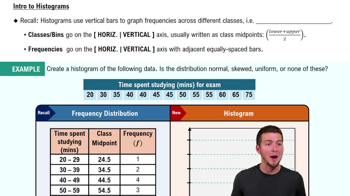
    Histograms use vertical bars with touching edges to represent the frequency distribution of quantitative data, with class midpoints on the x-axis and frequencies on the y-axis.
  • How do histograms help describe a population?
    Histograms help describe a population by visually displaying the distribution, shape, and variability of quantitative data, making it easier to identify patterns such as symmetry, skewness, and spread.
  • What is the difference between a histogram and a bar graph?
    A histogram displays quantitative data with touching bars representing frequency distributions, while a bar graph displays categorical data with separated bars.
  • What is the primary purpose of a histogram?
    The primary purpose of a histogram is to graphically represent the frequency distribution of quantitative data.
  • How can you determine the shape of a distribution from a histogram?
    You can determine the shape by observing the pattern of the bars: a bell shape indicates normal distribution, a peak to the left with a right tail indicates right-skewed, a peak to the right with a left tail indicates left-skewed, and roughly equal bar heights indicate a uniform distribution.
  • How do you find the modal class from a histogram?
    The modal class is the class interval corresponding to the tallest bar in the histogram, representing the highest frequency.
  • How can you identify left-skewed histograms?
    Left-skewed histograms have a peak on the right and a tail that extends to the left.
  • How can you identify approximately symmetric histograms?
    Approximately symmetric histograms have bars that are mirror images on either side of the center, forming a bell-shaped curve.
  • How can you determine if two histograms represent the same data?
    Two histograms represent the same data if they have the same class intervals and frequencies for each class.
  • How can you match a boxplot to a histogram's distribution?
    A boxplot that matches a histogram's distribution will reflect the same symmetry or skewness; for example, a symmetric histogram matches a symmetric boxplot, and a skewed histogram matches a skewed boxplot.
  • What is the most common graphical presentation of quantitative data?
    The most common graphical presentation of quantitative data is a histogram.
  • Why would someone use a histogram instead of a bar chart?
    A histogram is used for quantitative data to show frequency distributions, while a bar chart is used for categorical data.
  • How can you create a histogram from a dot plot of quantitative data?
    To create a histogram from a dot plot, group the data into class intervals (bins) and count the number of dots in each interval to determine the bar heights.
  • How can you represent a set of lap times for multiple days using a histogram?
    You can represent lap times by grouping them into class intervals and plotting the frequency of times in each interval as bars in a histogram.
  • Which descriptions of a histogram are true? (Select all that apply.)
    Histograms display quantitative data, use touching bars to represent frequencies, and show the distribution shape of the data.
  • What type of data is best analyzed and communicated using a histogram?
    Quantitative data that can be grouped into intervals is best analyzed and communicated using a histogram.
  • Which statements about histograms are true? (Select all that apply.)
    Histograms are used for quantitative data, display frequency distributions, and have bars that touch to indicate continuous intervals.
  • What type of graph is displayed when vertical bars touch and represent frequencies of quantitative data?
    A histogram is displayed when vertical bars touch and represent frequencies of quantitative data.
  • For what type of variables is it not possible to create a histogram or boxplot?
    It is not possible to create a histogram or boxplot for categorical (qualitative) variables.
  • How can you identify the histogram with the largest spread of data?
    The histogram with the largest spread has bars that extend over the widest range of values on the x-axis.
  • What should you consider when drawing a histogram?
    When drawing a histogram, ensure that class intervals are equal width, bars touch, and axes are labeled with class midpoints and frequencies.
  • How can you identify a histogram with an approximately uniform shape?
    A histogram is approximately uniform if all bars are about the same height, indicating similar frequencies across all intervals.
  • What is the term for a histogram where the right half is a mirror image of the left half?
    A histogram where the right half is a mirror image of the left half is called symmetric or normal.
  • What does the height of each bar in a histogram represent?
    The height of each bar in a histogram represents the frequency of data within that class interval.
  • In a probability histogram, what does each bar correspond to?
    In a probability histogram, each bar corresponds to the probability of data falling within a specific class interval.
  • How can you identify which histogram depicts a higher standard deviation?
    A histogram with bars spread out over a wider range of values depicts a higher standard deviation.
  • How do you determine the class width in a histogram?
    Class width is determined by subtracting the lower class boundary from the upper class boundary of a bin.
  • How do you find the frequency of the modal class in a histogram?
    The frequency of the modal class is the height of the tallest bar in the histogram.
  • What do histograms, Pareto charts, and scatter plots have in common?
    All three are graphical methods used to visualize data and identify patterns or trends.
  • How do you edit the bin size in a histogram chart?
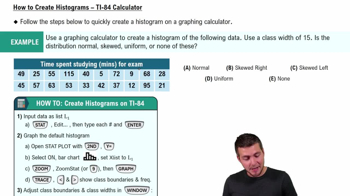
    To edit the bin size, adjust the class width parameter so that each bar represents a different interval size.
  • How do you describe the shape of a histogram?
    Describe the shape as normal (bell-shaped), right-skewed, left-skewed, or uniform, based on the pattern of the bars.
  • How can you classify a histogram using appropriate descriptions?
    Classify a histogram as normal, right-skewed, left-skewed, or uniform by analyzing the symmetry and spread of the bars.
  • How do you describe the shape of a given histogram?
    Describe the shape by noting if it is symmetric (normal), right-skewed, left-skewed, or uniform.
  • How can you identify left-skewed histograms?
    Left-skewed histograms have a peak on the right and a tail that extends to the left.
  • How can you identify a histogram that best indicates a normal distribution?
    A histogram that best indicates a normal distribution has a bell-shaped, symmetric curve with the highest frequency in the center.
  • How can you identify approximately symmetric histograms?
    Approximately symmetric histograms have bars that are mirror images on either side of the center.
  • What does a histogram summarize when showing percentages?
    A histogram can summarize the percentage of data values falling within each class interval.
  • The heights of the bars of a histogram correspond to what values?
    The heights of the bars of a histogram correspond to the frequencies of the data in each class interval.