What is the key difference between the binomial and hypergeometric distributions?
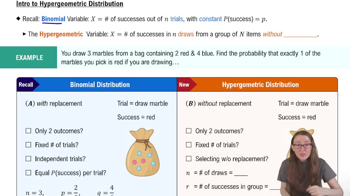
The binomial distribution assumes independent trials with constant probability, while the hypergeometric distribution deals with dependent trials where probabilities change as items are drawn.
What does 'without replacement' mean in the context of the hypergeometric distribution?
It means that once an item is drawn, it is not returned to the group, so it cannot be selected again in future draws.
How does drawing without replacement affect the probability of success in future draws?
The probability of success changes because the composition of the group changes after each draw, making the trials dependent.
What are the variables used in the hypergeometric probability formula?
The variables are n (number of draws), r (number of successes in the group), and N (total number of items in the group).
What does the denominator in the hypergeometric formula represent?
The denominator, N choose n, represents the total number of possible ways to draw n items from N items.
What does the numerator in the hypergeometric formula represent?
The numerator counts the number of ways to get the desired number of successes and failures in the draws.
How is a 'success' defined in the marble example from the transcript?
A success is defined as drawing a red marble from the bag.
What is the probability of drawing exactly one red marble in three draws with replacement?
The probability is 4/9 when drawing with replacement.
What is the probability of drawing exactly one red marble in three draws without replacement?
The probability is 3/5 when drawing without replacement.
Why is the hypergeometric formula recommended to be memorized?
Because it can be difficult to derive and is commonly used in problems involving dependent draws.
What is the formula for hypergeometric probability in terms of combinations?
The formula is: (r choose x) × (N - r choose n - x) divided by (N choose n).
In the marble example, what are the values for r, n, and N?
r = 2 (red marbles), n = 3 (draws), N = 6 (total marbles).
What condition must be met for a scenario to use the hypergeometric distribution?
The trials must be dependent, typically due to sampling without replacement from a finite group.
How does the hypergeometric distribution relate to the binomial distribution?
Both distributions find the probability of a certain number of successes in a fixed number of trials, but the hypergeometric is used when trials are dependent.
What is the outcome of each trial in the marble example?
Each trial results in either a success (red marble) or a failure (blue marble).
 Back
Back

 05:15
05:15