A statistical question is one that anticipates variability in the data and typically requires data collection and analysis to answer.
What is the difference between univariate data and bivariate data?
Univariate data involves observations on a single variable, while bivariate data involves observations on two variables, often to explore relationships between them.
What are some characteristics of the t test in statistics?
The t test is used to compare means, assumes data are approximately normally distributed, and is typically used when the population standard deviation is unknown and the sample size is small.
What is a response variable in statistics?
A response variable is the variable of interest that is measured or observed to assess the effect of changes in other variables.
What is true about convenience sampling?
Convenience sampling involves selecting a sample based on ease of access, which may not be representative of the population and can introduce bias.
For which population parameters is sampling not necessary?
Sampling is not necessary when data for the entire population is available, allowing direct calculation of population parameters.
What is the collection of observations on variables called in statistics?
The collection of observations on variables is called data.
What is an example of statistical quality control?
An example of statistical quality control is monitoring a manufacturing process by collecting and analyzing data to ensure products meet specified standards.
Which type of data have elements in common but do not fit into rigid rows and columns in a table?
Qualitative (categorical) data often have elements in common but may not fit into rigid rows and columns, as they are labels or attributes rather than numerical values.
What is true about the interquartile range (IQR) in statistics?
The interquartile range (IQR) measures the spread of the middle 50% of data and is calculated as the difference between the third quartile (Q3) and the first quartile (Q1).
What does using a 'by' clause with a stats command typically accomplish in data analysis?
Using a 'by' clause with a stats command typically groups the data by a specified variable and calculates statistics for each group separately.
What is not necessarily an outlier in a data set?
A data point that is unusual or extreme is not necessarily an outlier; it must be determined by statistical criteria, such as being outside 1.5 times the IQR from the quartiles.
What is the difference between quantitative and qualitative data?
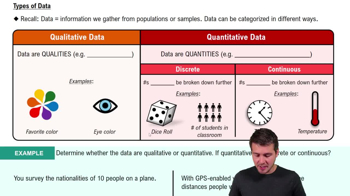
Quantitative data are numerical and can be measured or counted, while qualitative data are categorical and consist of labels or attributes.
What are some key concepts in introductory statistics?
Key concepts in introductory statistics include populations, samples, parameters, statistics, qualitative and quantitative data, and the distinction between discrete and continuous variables.
What are the four levels of measurement possible for data in statistics?
The four levels of measurement are nominal, ordinal, interval, and ratio.
What is the term for the group a researcher wants to study or describe in statistics?
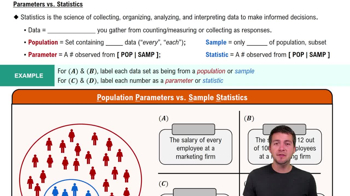
The group a researcher wants to study or describe is called the population.
Which level of measurement consists of categories only?
The nominal level of measurement consists of categories only.
What are the main topics covered in an introductory statistics unit on data types and sampling?
An introductory statistics unit on data types and sampling covers populations, samples, parameters, statistics, qualitative and quantitative data, and sampling methods.
What are the main concepts reviewed in an introductory statistics course?
Main concepts include the definitions of population and sample, the difference between parameters and statistics, and the types of data (qualitative and quantitative).
What are the key points to review for an introductory statistics unit on data and variables?
Key points include understanding the difference between populations and samples, parameters and statistics, and the classification of data as qualitative or quantitative.
What is the purpose of a statistics study guide in an introductory course?
A statistics study guide helps students review fundamental concepts such as populations, samples, parameters, statistics, and types of data.
What is not true about the tails in a distribution?
It is not true that the tails in a distribution always contain the majority of the data; typically, the tails represent the extreme values or outliers.
What do bivariate data consist of in statistics?
Bivariate data consist of observations on two variables for each subject or unit, often used to explore relationships between the variables.
What does it mean for a scientific experiment to be reproducible?
A reproducible scientific experiment is one that can be repeated by others and yield the same results, ensuring the reliability and validity of the findings.
In statistics, what does it mean if a statistic is resistant?
A statistic is considered resistant if it is not significantly affected by extreme values or outliers in the data set.
What is the definition of infant mortality rate in statistics?
The infant mortality rate is a statistical measure that represents the number of infant deaths (typically under one year of age) per a specified number of live births, often per 1,000 live births, within a given population and time period.
What does empirical evidence mean in the context of statistics?
Empirical evidence refers to information or data obtained through observation, measurement, or experimentation, rather than theory or pure logic.
In statistics, what does the term 'statistic' mean?
A statistic is a numerical value calculated from a sample of data, used to estimate or describe characteristics of a population.
 Back
Back
 04:24
04:24