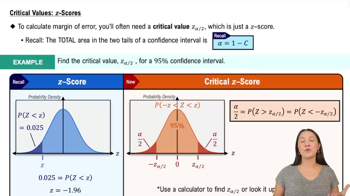
How do you find the critical z-score (z*) for a confidence level of 70%?
To find the critical z-score (z*) for a 70% confidence level, calculate alpha as 1 - 0.70 = 0.30, then divide by 2 to get 0.15. Find the z-score with 0.15 in the lower tail (or 0.85 to the left), which is approximately z* = ±1.04.
What is the best interpretation of the power of a significance test?
The power of a significance test is the probability that the test correctly rejects a false null hypothesis.
What is the probability of making a Type I error in hypothesis testing?
The probability of making a Type I error is equal to the significance level, alpha (α), which is the probability of rejecting a true null hypothesis.
What must be true for an estimator of a population parameter to be unbiased?
An estimator is unbiased if its expected value equals the true value of the population parameter.
What are the benefits of a large sample size in statistical estimation?
A large sample size reduces the margin of error, narrows confidence intervals, and increases the precision of parameter estimates.
What is the best definition of a point estimate?
A point estimate is a single value used to estimate a population parameter.
Given a time-series trend equation of the form y = 25.3 + 2.1x, how do you forecast the value for period 7?
Substitute x = 7 into the equation: y = 25.3 + 2.1 × 7.
Which of the following is a point estimate?
A sample mean (x̄) or sample proportion (p̂) is a point estimate of the corresponding population parameter.
Which of the following is not a conclusion of the central limit theorem?
The central limit theorem does not state that the sample mean always equals the population mean; it states that the distribution of sample means approaches normality as sample size increases.
Which of the following is not a conclusion of the central limit theorem?
The central limit theorem does not guarantee that individual samples are normally distributed, only that the distribution of sample means approaches normality as sample size increases.
What value of z should be used when making a 93% confidence interval for a population proportion?
For a 93% confidence interval, calculate alpha = 1 - 0.93 = 0.07, then alpha/2 = 0.035. The critical z value is the z-score with 0.035 in the lower tail (or 0.965 to the left), which is approximately z* ≈ 1.81.
Which of the following calculations is not derived from the confidence interval?
Calculations unrelated to the range, margin of error, or endpoints of the confidence interval are not derived from the confidence interval.
How does sample size affect the width of the confidence interval for the population mean?
Increasing the sample size decreases the width of the confidence interval, making the estimate more precise.
Which of the following is not true of the confidence level of a confidence interval?
It is not true that the confidence level gives the probability that a specific interval contains the parameter; rather, it reflects the long-run proportion of such intervals that will contain the parameter.
What is the purpose of calculating a confidence interval?
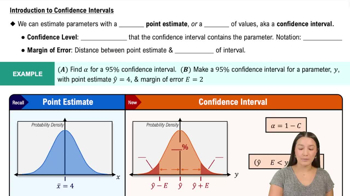
The purpose of a confidence interval is to estimate a population parameter by providing a range of values likely to contain the true value with a specified level of confidence.
How do you calculate the standard error of a data set?
The standard error is calculated as the standard deviation divided by the square root of the sample size: SE = s / √n.
What does a 99% confidence interval represent?
A 99% confidence interval represents a range of values that, in repeated sampling, would contain the true parameter 99% of the time.
Which of the following is true of the central limit theorem?
The central limit theorem states that the distribution of sample means approaches a normal distribution as the sample size increases, regardless of the population's distribution.
True or false? A larger sample size produces a longer confidence interval for a population mean.
False. A larger sample size produces a shorter (narrower) confidence interval.
Which Python module is commonly used to create confidence intervals?
The 'scipy.stats' module in Python is commonly used to create confidence intervals.
What is the most typical form of a calculated confidence interval?
A confidence interval is typically expressed as: point estimate ± margin of error.
If your p-value is 0.11, what does this indicate about statistical significance at the 0.05 level?
If the p-value is 0.11, it is greater than 0.05, so the result is not statistically significant at the 0.05 level.
What is an example of an independent sample?
An independent sample is one in which the selection of one observation does not influence the selection of another.
For a sample with degrees of freedom (df) = 5, what does this indicate?
Degrees of freedom (df) = 5 indicates that the sample size is 6 (since df = n - 1 for a sample mean).
What value is estimated with a confidence interval using the repeated-measures t statistic?
A confidence interval using the repeated-measures t statistic estimates the mean difference between paired observations.
Which of the following is correct about sample size?
A larger sample size leads to a smaller margin of error and a more precise confidence interval.
What is the impact of large samples on the p-value in hypothesis testing?
Larger samples tend to produce smaller p-values if an effect exists, making it easier to detect statistical significance.
How is the cumulative distribution function (CDF) denoted and defined?
The cumulative distribution function (CDF) is denoted as F(x) and defined as the probability that a random variable X is less than or equal to x: F(x) = P(X ≤ x).
If the confidence level is C%, how do you find alpha?
Alpha (α) is found by subtracting the confidence level from 1: α = 1 - C (where C is expressed as a decimal).
Which of the following is not a characteristic of the distribution of sample means?
It is not true that the distribution of sample means is always identical to the population distribution; it becomes approximately normal as sample size increases, regardless of the population's shape.
According to the law of large numbers, what happens as sample size increases?
As sample size increases, the sample mean tends to get closer to the population mean.
Suppose you are testing H0: p = 0.20 vs. Ha: p < 0.20 and the test statistic is 2.34. How do you find the p-value?
To find the p-value, calculate the probability of observing a test statistic as extreme or more extreme than 2.34 in the direction of the alternative hypothesis using the standard normal distribution.
What does the margin of error of a confidence interval account for?
The margin of error accounts for the maximum likely difference between the point estimate and the true population parameter due to sampling variability.
What is a confidence interval? Choose the best description.
A confidence interval is a range of values, derived from sample data, that is likely to contain the true value of a population parameter with a specified level of confidence.
Which of the following is not necessary to determine how large a sample to select from a population?
Information unrelated to the desired margin of error, confidence level, or population variability is not necessary to determine sample size.
What is the critical value zα/2 for a 90% confidence interval of the population mean?
For a 90% confidence interval, zα/2 is approximately 1.645.
When would you use the confidence interval formula for a proportion?
Use the confidence interval formula for a proportion when estimating the population proportion based on sample data.
Which of the following statements about the standard error of the estimate is true?
The standard error measures the variability of a sample statistic, such as the mean, from sample to sample.
Which of the following is important to ensure that a study has statistical validity?
Using appropriate sampling methods and sufficient sample size is important to ensure statistical validity.
What is the critical value for z for a hypothesis test using a 5% significance level?
For a two-tailed test with a 5% significance level, the critical z values are ±1.96.