Which of the following calculations is not derived from the confidence interval?
Calculations not involving the endpoints, margin of error, or range of the interval are not derived from the confidence interval.
What is the impact of large samples on the p-value in hypothesis testing?
Large samples tend to produce smaller p-values if an effect exists, increasing the likelihood of detecting statistical significance.
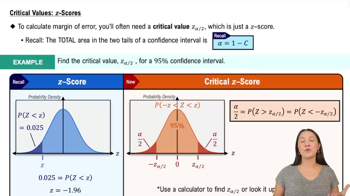
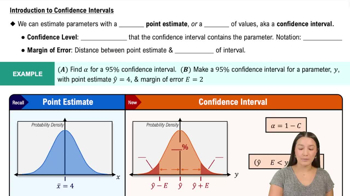
If the confidence level is C%, how do you find alpha?
Alpha (α) is calculated as α = 1 - C, where C is the confidence level expressed as a decimal.
What does the confidence interval suggest about the effectiveness of a treatment?
If the confidence interval for a treatment effect does not include zero (or the value indicating no effect), it suggests the treatment is effective at the given confidence level.
What is the correct formula for the n-period weighted moving average?
The n-period weighted moving average is calculated as the sum of each observation multiplied by its assigned weight, divided by the sum of the weights.
Which of the following provides information about the statistical validity of a study?
The confidence interval and its associated confidence level provide information about the statistical validity of a study's estimate.
Which criteria are necessary conditions for making a statistical inference?
Random sampling, appropriate sample size, and correct statistical methods are necessary for making valid statistical inferences.
For a specific confidence level, how do you find the corresponding critical z value?
For a given confidence level C, calculate α = 1 - C, then α/2, and find the z value with cumulative probability 1 - α/2.
Assuming a 90% confidence level, what is the approximate margin of error formula?
The margin of error is approximately z* × (standard error), where z* ≈ 1.645 for a 90% confidence level.
Each t distribution is identified by its ______.
Each t distribution is identified by its degrees of freedom.
What is the level of significance of a test of hypothesis?
The level of significance (alpha, α) is the probability of rejecting the null hypothesis when it is true.
How does a decrease in confidence level affect the sample size required?
A decrease in confidence level reduces the required sample size for a given margin of error.
If the confidence level is C%, how do you find alpha?
Alpha (α) is found by subtracting the confidence level from 1: α = 1 - C (with C as a decimal).
What does the confidence interval suggest about the effectiveness of a treatment?
If the confidence interval for the treatment effect excludes the value indicating no effect, it suggests the treatment is effective at the specified confidence level.
A hypothesis test has a significance level of 10%. What does this significance level represent?
A 10% significance level means there is a 10% probability of rejecting the null hypothesis when it is actually true (Type I error).
In order to make statistical inferences when testing a population parameter, what is required?
To make statistical inferences, you need a representative sample, appropriate statistical methods, and knowledge of sampling variability.
By the empirical rule, how many students in a class of 200 would score within the range μ ± 2σ?
By the empirical rule, about 95% of students would score within μ ± 2σ, so approximately 190 students in a class of 200.
What is the interpretation of a 96% confidence level?
A 96% confidence level means that if the procedure were repeated many times, about 96% of the resulting intervals would contain the true parameter.
In analysis of variance (ANOVA), what is measured by the MS values?
In ANOVA, MS (mean square) values measure the average variability within and between groups.
Which of the following accurately describes the critical region in hypothesis testing?
The critical region is the set of values for the test statistic that leads to rejection of the null hypothesis.
In interval estimation, as the sample size becomes larger, what happens to the interval estimate?
As sample size increases, the interval estimate (confidence interval) becomes narrower.
How do you express a confidence interval in the form of point estimate ± margin of error?
A confidence interval is expressed as: point estimate ± margin of error.
What does the central limit theorem say?
The central limit theorem states that the distribution of sample means approaches a normal distribution as the sample size increases, regardless of the population's distribution.