How do you calculate the probability of having three daughters in a row, assuming each child's gender is independent and the probability of having a daughter is 1/2?
To calculate the probability of having three daughters in a row, multiply the probability of having a daughter for each child: (1/2) × (1/2) × (1/2) = 1/8.
What does the upside down U symbol represent in set notation when discussing independent events?
The upside down U symbol represents 'and' in set notation. It is used to denote the probability of two events both occurring.
How do you determine if two events are independent when drawing marbles from a bag?
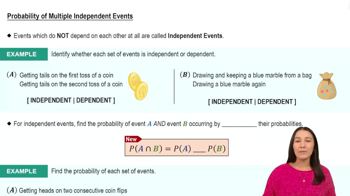
If the outcome of the first draw affects the probability of the second draw, the events are dependent. If the outcome of the first draw does not affect the second, the events are independent.
What is the probability of rolling an even number on a six-sided die and then rolling a 3 on the next roll?
The probability is (3/6) × (1/6) = 3/36, which simplifies to 0.08. This is found by multiplying the probability of each independent event.
How do you calculate the probability of three independent events all occurring?
Multiply the probability of each event together. The result gives the probability of all three events happening.
Why are the outcomes of two consecutive coin flips considered independent?
The result of the first coin flip does not affect the result of the second flip. Each flip has its own separate probability.
What is the probability of getting heads on two consecutive coin flips?
The probability is (1/2) × (1/2) = 1/4. This is because each flip is independent and has a 1/2 chance of heads.
What is the difference between independent and dependent events in probability?
Independent events do not affect each other's outcomes, while dependent events do. The probability calculation changes based on this relationship.
How many possible outcomes are there when flipping a coin twice?
There are four possible outcomes: heads-heads, heads-tails, tails-heads, and tails-tails. Only one of these matches both flips being heads.
What should you do if asked to find the 'and' probability for more than two independent events?
Continue multiplying the probabilities of each event together. This method works for any number of independent events.