Pie Charts quiz #1 Flashcards

Pie Charts quiz #1
Control buttons has been changed to "navigation" mode.
1/10
  • Which type of visual representation is best for comparing data as percentages of a whole?
    A pie chart is best for comparing data as percentages of a whole, as it visually displays each category's proportion relative to the total.
  • Which graph uses percentages to show how each category relates to all of the data?
    A pie chart uses percentages to show how each category relates to all of the data, with each wedge representing a category's percentage of the total.
  • How can information in a pie chart be accurately described?
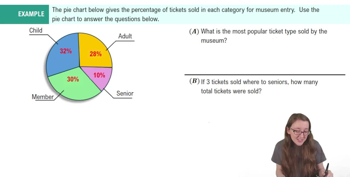
    Information in a pie chart can be accurately described by stating the percentage that each wedge (category) represents out of the total, allowing for comparison of each category's proportion within the whole.
  • When is it appropriate to display data with a pie chart?
    It is appropriate to display data with a pie chart when you have qualitative (categorical) data and want to show the percentage distribution of each category as part of a whole.
  • What is a good rule to follow for ordering the pieces of the pie in a pie chart?
    A good rule for ordering the pieces of a pie chart is to arrange the wedges in descending order of percentage, starting with the largest wedge and proceeding to the smallest.
  • How do you determine the number of wedges needed in a pie chart for a given dataset?
    The number of wedges in a pie chart equals the number of categories in the dataset. Each wedge represents one category.
  • What is the formula for calculating the percentage represented by a category in a pie chart?
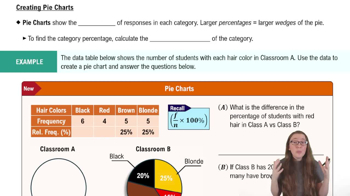
    The percentage is calculated by dividing the category frequency (f) by the total number of responses (n) and multiplying by 100. This gives the relative frequency as a percentage.
  • If a pie chart wedge is labeled 30%, what does this indicate about the category it represents?
    It indicates that 30% of the total responses fall into that category. The wedge's size visually corresponds to this percentage of the whole pie.
  • Why is it important to distinguish between percentages and frequencies when interpreting pie charts?
    Pie charts display percentages, not raw frequencies, so differences in wedge sizes reflect differences in proportions, not necessarily in counts. Misinterpreting this can lead to incorrect conclusions about the data.
  • How can you find the actual number of responses for a category if you know its percentage and the total number of responses?
    Multiply the percentage (as a decimal) by the total number of responses. This gives the frequency for that category.