What is a prediction interval in regression analysis?
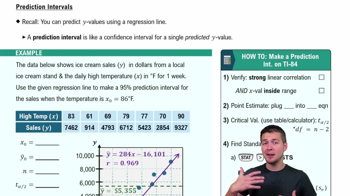
A prediction interval provides a range of values within which a single predicted y value is expected to fall, with a certain level of confidence.
How is a prediction interval similar to a confidence interval?
Both intervals use a point estimate and a margin of error to express uncertainty, but a prediction interval is for a single predicted value rather than the mean.
What is the first condition you must check before constructing a prediction interval?
You must verify that there is a strong linear correlation between the variables.
Why must the x value be within the data range when constructing a prediction interval?
Because prediction intervals are only reliable when the x value is within the observed data range; extrapolation can lead to inaccurate results.
How do you calculate the point estimate for a prediction interval?
Plug the given x value into the regression equation to find the predicted y value (y hat).
What critical value is used in the margin of error for a prediction interval?
The critical value is taken from the t-distribution, based on the desired confidence level and degrees of freedom (n - 2).
How do you determine the degrees of freedom for the t-distribution in this context?
Degrees of freedom are calculated as the number of data pairs (n) minus 2.
What is the standard error in the context of prediction intervals, and how is it found?
The standard error measures the typical distance between observed and predicted y values and can be found using the regression output (often labeled as 's').
Which calculator function helps you quickly find the standard error for regression?
The 'LinReg Test' function on a graphing calculator provides the standard error.
What statistics about the x variable are needed for the margin of error calculation?
You need the mean of x (x bar), the sum of x values squared (Σx²), and the sum of x values (Σx).
What is the general formula for the margin of error in a prediction interval?
The margin of error is the critical t value times the standard error, multiplied by the square root of [1 + 1/n + (x₀ - x̄)² / (n * Σx² - (Σx)²)].
How do you calculate the lower and upper bounds of a prediction interval?
Subtract the margin of error from the point estimate for the lower bound and add it for the upper bound.
How would you interpret a 95% prediction interval in words?
You would say you are 95% confident that the actual y value for the given x will fall within the calculated interval.
Why is the margin of error for a prediction interval typically larger than for a confidence interval?
Because a prediction interval accounts for both the uncertainty in estimating the mean and the variability of individual observations.
What is the main purpose of constructing a prediction interval in regression analysis?
To provide a range where a single future observation is likely to fall, given a specific x value.
 Back
Back
 09:00
09:00