What are two things you should do to make sure your statistics are representative of the population?
You should use a random sample and ensure the sample size is large enough to reflect the diversity of the population.
Why is a sample used more often than a population in statistical studies?
A sample is used more often because it is usually impractical or impossible to collect data from the entire population, and a well-chosen sample can provide reliable information about the population.
How is a sample related to a population in statistics?
A sample is a subset of the population selected for study, and it is used to make inferences about the population as a whole.
What is the main reason a sample is used more often than a population in statistical analysis?
A sample is used more often because it is more practical, less time-consuming, and less costly than studying the entire population.
How does a sample allow us to make conclusions about a population?
By analyzing a representative sample, we can estimate population parameters and make inferences about the entire population.
What is a voluntary response sample, and how can you identify one?
A voluntary response sample is one in which participants choose themselves to be part of the sample, often leading to bias because not everyone in the population has an equal chance of being selected.
In what situation can the sample proportion be assumed to follow a normal distribution?
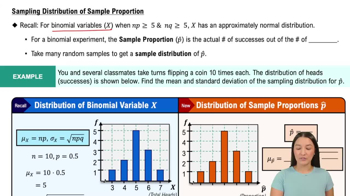
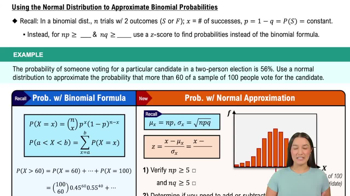
The sample proportion can be assumed to follow a normal distribution when both np ≥ 5 and nq ≥ 5, where n is the sample size, p is the probability of success, and q = 1 - p.
Which rule about sampling distributions for the mean is false: the mean of the sampling distribution equals the population mean, the standard deviation decreases as sample size increases, or the distribution is always normal regardless of sample size?
The rule that the distribution is always normal regardless of sample size is false; the sampling distribution is approximately normal only when certain conditions (such as a large enough sample size) are met.
What is a true statement regarding the sampling distribution of the sample mean?
The mean of the sampling distribution of the sample mean equals the population mean, and its standard deviation decreases as the sample size increases.
What effect does decreasing the sample size have on the distribution of sample means?
Decreasing the sample size increases the standard deviation of the sampling distribution, making the sample means more spread out.
How does increasing the sample size affect how accurately the sample represents the population?
A larger sample size generally leads to a more accurate representation of the population, reducing sampling error.
What is a true property of the sampling distribution of the sample mean?
The sampling distribution of the sample mean has a mean equal to the population mean and a standard deviation equal to the population standard deviation divided by the square root of the sample size.
Why is a sample used more often than a population in statistical inference?
Because collecting data from the entire population is often impractical, a sample provides a manageable way to estimate population parameters.
How does a sample relate to the population parameter it estimates?
A sample provides statistics that are used as estimates for the corresponding population parameters.
What is a representative sample in statistics?
A representative sample is a subset of the population that accurately reflects the characteristics of the entire population.
Why is sampling preferred over conducting a census in most studies?
Sampling is preferred because it is less expensive, less time-consuming, and more practical than conducting a census of the entire population.
How does a sample relate to a population in terms of statistical inference?
A sample is used to make inferences about the population by estimating population parameters based on sample statistics.
What is a voluntary response sample, and why might it be problematic?
A voluntary response sample consists of individuals who choose to participate, which can lead to bias because those who respond may not be representative of the entire population.
What is the difference between a census and sampling in statistics?
A census collects data from every member of the population, while sampling collects data from a subset of the population.
Which of the following is not a property of the sampling distribution of the variance: unbiasedness, normality for all sample sizes, or decreasing standard error with increasing sample size?
The property that the sampling distribution of the variance is normal for all sample sizes is not true; normality depends on sample size and population distribution.
Why is a sample used more often than a population when calculating statistics?
Because it is often impractical to measure the entire population, a sample provides a feasible way to estimate population characteristics.
How is a sample related to a population in the context of sampling distributions?
A sample is drawn from the population, and the distribution of a statistic (like the sample mean or proportion) from many samples forms the sampling distribution.
How does a sample relate to a population in terms of estimating proportions?
The sample proportion is used as an estimate of the population proportion, and its distribution can be analyzed to make inferences about the population.
What is the term for the portion of the population selected for a study?
The portion of the population selected for a study is called a sample.
Why are population parameters often difficult to calculate?
Population parameters are difficult to calculate because it is usually impractical or impossible to collect data from every member of the population.