What does it mean if a distribution has zero variance?
If a distribution has zero variance, all data values are identical and there is no spread; every value equals the mean.
How does the standard deviation relate to the spread of a normal distribution?
A normal distribution with a greater standard deviation has more spread, meaning its values are more dispersed around the mean.
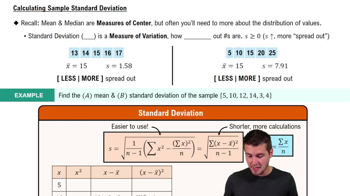
Which formula is used to calculate the standard deviation of sample data?
The sample standard deviation is calculated as s = sqrt([Σx² - (Σx)²/n] / (n-1)).
What is variance and what is standard deviation?
Variance measures the average squared deviation from the mean; standard deviation is the positive square root of the variance and indicates data spread.
Which quantity is commonly used to generate error bars on a graph?
Standard deviation is commonly used to generate error bars, representing variability around the mean.
Which formulas should you use for variance and standard deviation in a sample?
Sample variance: s² = [Σx² - (Σx)²/n] / (n-1); Sample standard deviation: s = sqrt(s²).
How do you calculate the variance of a data set such as 0.40, 0.72, 1.15, 2.14?
To calculate variance, find the mean, subtract the mean from each value, square the differences, sum them, and divide by (n-1) for a sample.
What is the relationship between variance and standard deviation?
Standard deviation is the positive square root of the variance.
How do you calculate the standard deviation of a data set such as 4, 8, 12, 24?
Find the mean, subtract it from each value, square the differences, sum them, divide by (n-1), and take the square root.
What is key to generating a bell curve in statistics?
A bell curve is generated by data that follows a normal distribution, characterized by its mean and standard deviation.
What happens to the graph of the normal curve as the standard deviation decreases?
As the standard deviation decreases, the normal curve becomes narrower and taller, indicating less spread.
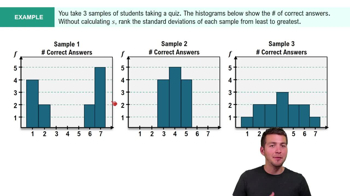
How can you determine which data set has the smallest standard deviation from histograms?
The data set with values most closely clustered around the mean has the smallest standard deviation.
What can be said about a set of data with a standard deviation of 0?
All data values are identical; there is no variability.
How do you calculate the standard deviation of the data set 65, 75, 100, 130?
Find the mean, subtract it from each value, square the differences, sum them, divide by (n-1), and take the square root.
Which is not a property of the standard deviation?
Standard deviation cannot be negative; it is always zero or positive.
Which statistics can turn negative?
Deviation scores (individual differences from the mean) can be negative, but variance and standard deviation cannot.
How can you tell which histogram depicts a higher standard deviation?
The histogram with data more spread out from the mean depicts a higher standard deviation.
How do you calculate the variance of the data set 1, 2, 4, 5?
Find the mean, subtract it from each value, square the differences, sum them, and divide by (n-1).
How do you calculate the standard deviation of a data set such as 0.5, 1.5, 2.0, 2.5?
Find the mean, subtract it from each value, square the differences, sum them, divide by (n-1), and take the square root.
How do you calculate the variance of a sample data set with a single value, such as 8?
A sample with only one value has undefined variance, as the denominator (n-1) is zero.
What does it mean for a sample to have a standard deviation of zero?
All sample values are identical; there is no spread.
How do you calculate the standard deviation of a sample data set with a single value, such as 2?
A sample with only one value has a standard deviation of zero.
What conditions produce a negative z-score?
A z-score is negative when the observation is below the mean.
How do you calculate the standard deviation of a population data set with a single value, such as 3?
A population with only one value has a standard deviation of zero.
Which sample will have the smallest value for the estimated standard error?
The sample with the smallest standard deviation and largest sample size will have the smallest standard error.
Which list of data will have the smallest standard deviation?
The list with values closest to each other (least spread) will have the smallest standard deviation.
What happens to the graph of the normal curve as the standard deviation decreases?
The curve becomes narrower and taller, indicating less variability.
What can be said about a set of data with a standard deviation of 0?
All values are the same; there is no variability.
What happens to the graph of the normal curve as the mean increases?
The curve shifts horizontally to the right, but its shape remains unchanged.
Which is not a property of the standard deviation?
Standard deviation cannot be negative.
How can you tell which histogram depicts a higher standard deviation?
The histogram with data more spread out from the mean has a higher standard deviation.
Why is the range less desirable than the standard deviation as a measure of dispersion?
The range only considers the two extreme values and ignores the distribution of other data points, while standard deviation uses all data values.
What can be said about a set of data with a standard deviation of 0?
All values are identical; there is no spread.
Which is not a property of the standard deviation?
Standard deviation cannot be negative.
How can you tell which histogram depicts a higher standard deviation?
The histogram with more spread out data has a higher standard deviation.
Which symbol identifies the population standard deviation?
The symbol σ (lowercase sigma) identifies the population standard deviation.
How do you calculate population variance if n = 10, mean μ = 21, and standard deviation σ = 3?
Population variance is σ²; if σ = 3, variance = 9.
Which statistic is a good point estimator for the population standard deviation?
The sample standard deviation (s) is a good point estimator for the population standard deviation.
Which combination of factors produces the largest value for the standard error?
A large standard deviation and a small sample size produce the largest standard error.
What is the relationship between variance and standard deviation for a sample data set?
Standard deviation is the positive square root of the sample variance.