Standard Deviation quiz #2 Flashcards

Standard Deviation quiz #2
Control buttons has been changed to "navigation" mode.
1/40
  • What is measured by the denominator of the z-score test statistic?
    The denominator measures the standard deviation or standard error, representing variability.
  • Standard deviation is a measure of which characteristic of data?
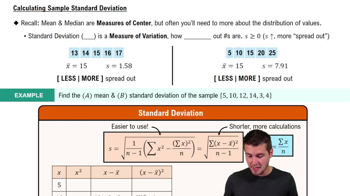
    Standard deviation measures the spread or variability of data values.
  • What is the correct formula for population variance?
    Population variance: σ² = [Σ(x - μ)²] / N.
  • Given a sample with mean m = 50 and standard deviation s = 12, what does s represent?
    s = 12 represents the average spread of data values around the mean of 50.
  • Which statistic is a good point estimator for the population variance?
    The sample variance (s²) is a good point estimator for the population variance.
  • Which normal curve has the smallest standard deviation?
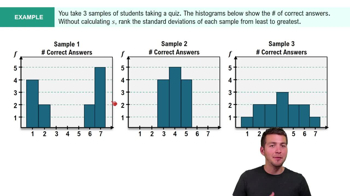
    The curve that is narrowest and tallest has the smallest standard deviation.
  • Why is the standard deviation used more frequently than the variance?
    Standard deviation is in the same units as the data, making it easier to interpret than variance, which is in squared units.
  • Which normal curve has the largest standard deviation?
    The curve that is widest and flatter has the largest standard deviation.
  • Which symbol identifies the sample variance?
    The symbol s² identifies the sample variance.
  • Which quantity is the positive square root of the variance?
    Standard deviation is the positive square root of the variance.
  • How do you calculate the standard deviation of a sample data set with a single value, such as 7?
    A sample with only one value has a standard deviation of zero.
  • If the standard deviation for a set of data is 0, what does this indicate?
    All data values are identical; there is no spread.
  • For a population with mean μ = 65 and standard deviation σ = 4, what is the variance?
    Variance is σ² = 16.
  • How do we measure total risk in statistics?
    Total risk is measured by variance and standard deviation.
  • Does the value of the standard deviation depend on the value of the mean?
    No, standard deviation measures spread, not the central value.
  • How is standard error calculated?
    Standard error is calculated as the standard deviation divided by the square root of the sample size: SE = s / sqrt(n).
  • What is the value of sp for a set of data?
    sp typically refers to the pooled standard deviation, calculated using the variances and sizes of two samples.
  • How do you calculate the variance for a sample of n = 4 scores with SS = 60?
    Variance = SS / (n-1) = 60 / 3 = 20.
  • If a population has mean μ = 9 and Σx = 54, how many scores are in the population?
    Number of scores, N = Σx / μ = 54 / 9 = 6.
  • How do you calculate the standard error and assess normality?
    Standard error is s / sqrt(n); normality is assessed by the shape of the data distribution.
  • What is true regarding the standard error of the estimate?
    Standard error measures the typical distance between sample means and the population mean.
  • How do you calculate the variance for a sample of n = 4 scores with SS = 60?
    Variance = SS / (n-1) = 60 / 3 = 20.
  • For a population with mean μ = 40 and standard deviation σ = 8, what is the variance?
    Variance is σ² = 64.
  • What is the typical size of a prediction error for a model?
    The typical size of a prediction error is measured by the standard deviation of the residuals.
  • If the variance is 3.6 grams, what is the standard deviation?
    Standard deviation is sqrt(3.6) grams.
  • How do you calculate the standard deviation for a sample of n = 4 scores?
    Find the mean, subtract it from each value, square the differences, sum them, divide by (n-1), and take the square root.
  • For a population with mean μ = 100 and standard deviation σ = 20, what is the variance?
    Variance is σ² = 400.
  • How do you calculate the standard deviation for a set of scores such as 10?
    A set with only one score has a standard deviation of zero.
  • What does Σ(x - μ) represent?
    Σ(x - μ) is the sum of deviations from the mean, which always equals zero.
  • Which symbol is used to identify the standard error of the mean?
    The symbol SE or σM is used for the standard error of the mean.
  • A sample of n = 15 scores has mean m = 20 and variance s² = 9. What is the sample standard deviation?
    Sample standard deviation is s = sqrt(9) = 3.
  • Given a sample variance of 6, what is the sample standard deviation?
    Sample standard deviation is s = sqrt(6).
  • Which statement about the shape of a normally distributed data set is true?
    A normal distribution is symmetric and bell-shaped, with mean, median, and mode equal.
  • Which is correct regarding the standard deviation formula?
    Standard deviation is the positive square root of the variance.
  • Which is not a step used in calculating standard deviation?
    Standard deviation calculation does not involve ignoring data values; all values are used.
  • A sample of n = 5 scores has mean m = 20 and variance s² = 4. What is the sample standard deviation?
    Sample standard deviation is s = sqrt(4) = 2.
  • Which statement is true about variance?
    Variance is always zero or positive and measures average squared deviation from the mean.
  • Given a sample with standard deviation s = 9, what does this indicate?
    It indicates the average spread of data values around the mean is 9 units.
  • Which three quantities are needed to calculate the variance?
    You need the sum of squared values, the sum of values, and the sample size.
  • Which statement is true of the standard deviation?
    Standard deviation is always zero or positive and measures data spread.