Steps in Hypothesis Testing quiz #1 Flashcards

Steps in Hypothesis Testing quiz #1
Control buttons has been changed to "navigation" mode.
1/40
  • What is defined by the significance level (alpha) in a hypothesis test?
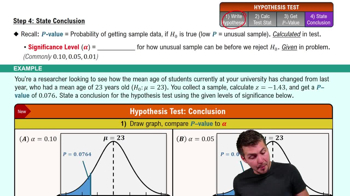
    The significance level (alpha) defines the threshold for how unusual a sample must be before rejecting the null hypothesis; it is the probability of rejecting the null hypothesis when it is actually true.
  • Which of the following is not a criterion for making a decision in a hypothesis test?
    Making a decision in a hypothesis test does not involve personal judgment; it is based on comparing the p-value to the significance level (alpha).
  • What are the assumptions for conducting a significance test for a proportion?
    Assumptions for a significance test for a proportion include random sampling and a sufficiently large sample size so that the sampling distribution of the proportion is approximately normal.
  • What is the general formula for the test statistic used in a test of paired samples?
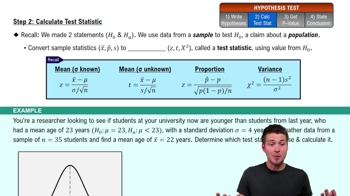
    The test statistic for paired samples is typically t = (mean of differences) / (standard deviation of differences / sqrt(n)), where n is the number of pairs.
  • If you conduct a hypothesis test and your p-value is 0.08, what can you conclude?
    If the p-value is 0.08, you fail to reject the null hypothesis at the 0.05 significance level, as the p-value is greater than alpha.
  • What is not true when testing a claim about a proportion?
    It is not true that the null hypothesis for a proportion uses a 'not equal to' sign; the null hypothesis always uses an equal sign.
  • Which of the following is not a criterion for making a decision in a hypothesis test?
    Decisions in hypothesis testing are not based on intuition; they are based on the comparison of the p-value to the significance level.
  • What is not true about p-values in hypothesis testing?
    It is not true that a high p-value provides strong evidence against the null hypothesis; a high p-value indicates the sample is not unusual under the null hypothesis.
  • When is it appropriate to use the paired difference t-test?
    The paired difference t-test is appropriate when comparing two related samples, such as measurements taken before and after a treatment on the same subjects.
  • What is the level of significance in a hypothesis test?
    The level of significance (alpha) is a predetermined threshold that determines how unlikely a sample result must be before rejecting the null hypothesis.
  • What assumptions are required to use the two-sample test of means?
    Assumptions for the two-sample test of means include independent random samples from each population and that the sampling distributions of the means are approximately normal.
  • What are the two possible decisions you can make when performing a hypothesis test?
    The two possible decisions are to reject the null hypothesis or to fail to reject the null hypothesis.
  • How would you accurately describe a hypothesis test?
    A hypothesis test is a statistical procedure used to evaluate a claim about a population parameter using sample data.
  • Which statements about Type I error are correct?
    A Type I error occurs when the null hypothesis is rejected when it is actually true; its probability is equal to the significance level (alpha).
  • What are the two types of hypotheses used in a hypothesis test and how are they related?
    The two types are the null hypothesis (H0), which states a claim about a population parameter, and the alternative hypothesis (Ha), which challenges that claim; they are mutually exclusive.
  • How do you write a null hypothesis of the form μ ≤ 7 and an alternative hypothesis of μ > 7?
    The null hypothesis is H0: μ ≤ 7, and the alternative hypothesis is Ha: μ > 7; this setup is used for a right-tailed test.
  • What is not true when testing a claim about a standard deviation or variance?
    It is not true that the null hypothesis for variance uses a 'not equal to' sign; the null hypothesis always uses an equal sign.
  • How do you determine the direction of a hypothesis test based on the null hypothesis H0: μ ≤ 16.9?
    A null hypothesis of H0: μ ≤ 16.9 with an alternative of μ > 16.9 indicates a right-tailed test.
  • What does a test statistic value of 2.23 indicate in a hypothesis test?
    A test statistic of 2.23 suggests the sample mean is 2.23 standard deviations above the hypothesized mean; the p-value can be calculated accordingly to determine significance.
  • How do you determine the direction of a hypothesis test based on the null hypothesis H0: x ≤ 10.7?
    A null hypothesis of H0: x ≤ 10.7 with an alternative of x > 10.7 indicates a right-tailed test.
  • What is a correct statement comparing one-tailed and two-tailed hypothesis tests?
    A one-tailed test evaluates deviations in one direction from the null hypothesis, while a two-tailed test evaluates deviations in both directions.
  • Which form of alternative hypothesis makes a hypothesis test two-tailed?
    An alternative hypothesis of the form Ha: parameter ≠ value makes the test two-tailed.
  • How do you write a null hypothesis p ≥ 0.44 and an alternative hypothesis p < 0.44?
    The null hypothesis is H0: p ≥ 0.44, and the alternative hypothesis is Ha: p < 0.44; this setup is used for a left-tailed test.
  • Which of the following is not one of the six steps in the hypothesis testing procedure?
    Personal opinion is not a step in the hypothesis testing procedure; the steps are systematic and based on statistical rules.
  • What does a test statistic value of 1.77 indicate in a hypothesis test?
    A test statistic of 1.77 means the sample mean is 1.77 standard deviations above the hypothesized mean; the p-value can be calculated to assess significance.
  • How is the null hypothesis of the independent-samples t-test verbalized?
    The null hypothesis for the independent-samples t-test states that the means of the two populations are equal.
  • Which statement is consistent with making a Type I error?
    A Type I error occurs when you reject the null hypothesis even though it is actually true.
  • What does a test statistic value of 1.41 indicate in a hypothesis test?
    A test statistic of 1.41 means the sample mean is 1.41 standard deviations above the hypothesized mean; the p-value can be calculated to determine significance.
  • Which types of hypothesis tests are considered one-tailed?
    Tests with alternative hypotheses of the form Ha: parameter > value or Ha: parameter < value are one-tailed.
  • What is an accurate definition of a Type I error?
    A Type I error is rejecting the null hypothesis when it is actually true.
  • What does a test statistic value of -2.12 indicate in a hypothesis test?
    A test statistic of -2.12 means the sample mean is 2.12 standard deviations below the hypothesized mean; the p-value can be calculated to assess significance.
  • How do you write a null hypothesis μ ≥ 38 and an alternative hypothesis μ < 38?
    The null hypothesis is H0: μ ≥ 38, and the alternative hypothesis is Ha: μ < 38; this setup is used for a left-tailed test.
  • What does a test statistic value of 1.34 indicate in a hypothesis test?
    A test statistic of 1.34 means the sample mean is 1.34 standard deviations above the hypothesized mean; the p-value can be calculated to determine significance.
  • If you conduct a hypothesis test and your p-value is 0.002, what can you conclude?
    If the p-value is 0.002, you reject the null hypothesis at common significance levels (such as 0.05 or 0.01), as the p-value is very small.
  • What situation involves testing a claim about a single population proportion?
    Testing whether the proportion of a population with a certain characteristic equals a specified value involves a single population proportion.
  • What is a valid one-sample hypothesis test?
    A valid one-sample hypothesis test compares a sample statistic (such as mean or proportion) to a claimed population value using a null and alternative hypothesis.
  • Which symbol represents a test statistic used to test a hypothesis about a population mean?
    The test statistic for a population mean is typically represented by z (if population standard deviation is known) or t (if it is unknown).
  • What would be an appropriate null hypothesis in hypothesis testing?
    An appropriate null hypothesis states that a population parameter equals a specific value, such as H0: μ = value or H0: p = value.
  • If testing H0: p = 0.20 vs Ha: p < 0.20 and the test statistic is -2.34, how do you find the p-value?
    The p-value is the probability of observing a test statistic less than -2.34 under the null hypothesis; it can be found using the standard normal distribution.
  • Which statement is consistent with hypothesis testing?
    Hypothesis testing involves using sample data to evaluate a claim about a population parameter by comparing the p-value to the significance level.