What does not need to be known in order to compute the p-value?
Personal opinion or subjective judgment is not needed to compute the p-value; only the test statistic and the distribution under the null hypothesis are required.
When is a researcher at risk of making a Type II error?
A researcher is at risk of making a Type II error when they fail to reject the null hypothesis even though the alternative hypothesis is true.
How do you determine the direction of a hypothesis test based on the null hypothesis H0: p ≤ 8.1?
A null hypothesis of H0: p ≤ 8.1 with an alternative of p > 8.1 indicates a right-tailed test.
If you conduct a hypothesis test and your p-value is 0.016, what can you conclude?
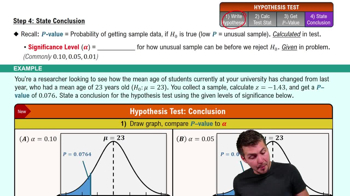
If the p-value is 0.016, you reject the null hypothesis at the 0.05 significance level, as the p-value is less than alpha.
If you conduct a hypothesis test and your p-value is 0.13, what can you conclude?
If the p-value is 0.13, you fail to reject the null hypothesis at the 0.05 significance level, as the p-value is greater than alpha.
What is the decision rule when using the p-value approach to hypothesis testing?
If the p-value is less than the significance level (alpha), reject the null hypothesis; otherwise, fail to reject the null hypothesis.
What question is necessary to ask when interrogating statistical validity in hypothesis testing?
Is the sample size large enough and is the sampling method appropriate for the test being used?
What is an accurate definition of a Type II error?
A Type II error is failing to reject the null hypothesis when the alternative hypothesis is actually true.
If you conduct a hypothesis test and your p-value is 0.02, what can you conclude?
If the p-value is 0.02, you reject the null hypothesis at the 0.05 significance level, as the p-value is less than alpha.
What is not an assumption of the paired-samples t test?
Independence between samples is not assumed in the paired-samples t test; the samples must be related.
Which of the following is not one of the steps in a one-sample t-test?
Guessing the result is not a step in a one-sample t-test; all steps are systematic and based on statistical procedures.
Which form of hypothesis has the appropriate structure for a null hypothesis?
The null hypothesis should be of the form H0: parameter = value.
When is there a risk of a Type I error in hypothesis testing?
There is a risk of a Type I error whenever you reject the null hypothesis; the probability of this error is the significance level (alpha).
What is not assumed before starting an ANOVA test?
Equal sample sizes are not required for ANOVA; the main assumptions are normality and equal variances.
What is the initial step in conducting a hypothesis test?
The initial step is to state the null and alternative hypotheses.
What assumptions are required to use the two-sample test of means?
Assumptions include independent random samples and approximately normal sampling distributions of the means.
What is not a conclusion of the central limit theorem?
The central limit theorem does not guarantee that the population distribution is normal; it states that the sampling distribution of the sample mean approaches normality as sample size increases.
Which of the following is not a criterion for making a decision in a hypothesis test?
Decisions are not based on subjective judgment; they are based on statistical comparison of p-value and alpha.
What is not true about p-values in hypothesis testing?
It is not true that a large p-value indicates strong evidence against the null hypothesis; a large p-value suggests the sample is not unusual under the null hypothesis.
What are the two possible decisions you can make from performing a hypothesis test?
You can either reject the null hypothesis or fail to reject the null hypothesis.
In hypothesis testing, what is the role of the null hypothesis?
The null hypothesis represents the default claim about a population parameter that is tested against sample data.
What is the most relevant null hypothesis for evaluating sample data?
The most relevant null hypothesis is the one that states the population parameter equals the claimed value.
Which statistical test is commonly used to compare a sample mean to a population mean?
The one-sample t-test or z-test is commonly used to compare a sample mean to a population mean.
What is an appropriate null hypothesis for an experiment testing a population mean?
An appropriate null hypothesis is H0: μ = value, where value is the claimed population mean.
What is not a conclusion of the central limit theorem?
The central limit theorem does not state that the population mean equals the sample mean; it states that the sampling distribution of the sample mean approaches normality as sample size increases.
What is not a characteristic of the t test?
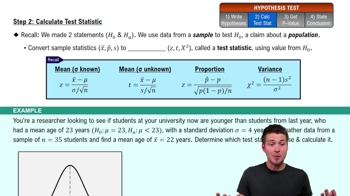
The t test does not require the population standard deviation to be known; it is used when the population standard deviation is unknown.
Which of the following is not a criterion for making a decision in a hypothesis test?
Decisions are not based on personal beliefs; they are based on statistical comparison of p-value and alpha.
What is not a true statement about error in hypothesis testing?
It is not true that errors can be completely eliminated; Type I and Type II errors are inherent risks in hypothesis testing.
What is not true when testing a claim about a proportion?
It is not true that the null hypothesis for a proportion uses a 'not equal to' sign; it always uses an equal sign.
What is not true about p-values in hypothesis testing?
It is not true that a high p-value provides strong evidence against the null hypothesis; a high p-value indicates the sample is not unusual under the null hypothesis.
What is a correct interpretation of a p-value that is not very small?
A p-value that is not very small indicates that the sample data is not unusual under the null hypothesis, so you fail to reject the null hypothesis.
What are the two possible decisions you can make from performing a hypothesis test?
You can either reject the null hypothesis or fail to reject the null hypothesis.
In hypothesis testing, what is the role of the alternative hypothesis?
The alternative hypothesis represents the claim that challenges the null hypothesis and is supported if the null is rejected.
What is not a conclusion of the central limit theorem?
The central limit theorem does not state that the population distribution becomes normal; it states that the sampling distribution of the sample mean approaches normality as sample size increases.
Which of the following is not a criterion for making a decision in a hypothesis test?
Decisions are not based on subjective judgment; they are based on statistical comparison of p-value and alpha.
What is not a conclusion of the central limit theorem?
The central limit theorem does not guarantee that the sample mean equals the population mean; it states that the sampling distribution of the sample mean approaches normality as sample size increases.
Which of the following is not a criterion for making a decision in a hypothesis test?
Decisions are not based on personal beliefs; they are based on statistical comparison of p-value and alpha.
What is not a true statement about error in hypothesis testing?
It is not true that errors can be completely avoided; Type I and Type II errors are inherent risks in hypothesis testing.
What is not true when testing a claim about a proportion?
It is not true that the null hypothesis for a proportion uses a 'not equal to' sign; it always uses an equal sign.
What is not true about p-values in hypothesis testing?
It is not true that a high p-value provides strong evidence against the null hypothesis; a high p-value indicates the sample is not unusual under the null hypothesis.