Visualizing Qualitative vs. Quantitative Data quiz #1 Flashcards

Visualizing Qualitative vs. Quantitative Data quiz #1
Control buttons has been changed to "navigation" mode.
1/40
  • What is an example of quantitative data collected from a group of students?
    An example of quantitative data is the heights or test scores of students, as these are numerical values.
  • Which type of graph uses percentages to display its data?
    A pie chart uses percentages to display its data.
  • Which observation is qualitative rather than quantitative?
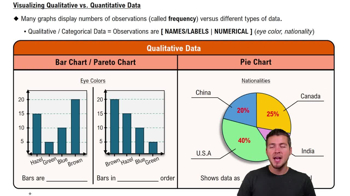
    An observation such as eye color or nationality is qualitative, as it describes categories or labels rather than numbers.
  • Which type of graph best shows data that are parts of a whole?
    A pie chart best shows data that are parts of a whole.
  • Which is the best type of graph to show percents of a whole?
    A pie chart is the best type of graph to show percents of a whole.
  • What is the difference between qualitative and quantitative data?
    Qualitative data consists of categories or labels, while quantitative data consists of numerical values.
  • Which type of chart can be used to plot one or more data series on a secondary axis?
    A bar chart or line chart can be used to plot multiple data series, including on a secondary axis.
  • How do qualitative and quantitative data differ?
    Qualitative data describes categories or labels; quantitative data describes numerical measurements.
  • How can you identify a table that shows exponential decay?
    A table showing exponential decay will have values that decrease rapidly at first and then more slowly, following a multiplicative pattern.
  • What is an example of quantitative data?
    An example of quantitative data is the number of students in a class or their test scores.
  • Which type of graph displays data as percentages?
    Pie charts display data as percentages.
  • When examining data to look for trends, what should you do?
    You should visualize the data using appropriate charts or graphs to identify patterns or trends.
  • What generalization can be made from a graph showing frequencies?
    A graph showing frequencies allows you to generalize which categories or values are most or least common in the data set.
  • How do you determine the value of a statistic associated with a graph?
    You determine the value by interpreting the relevant measure shown, such as frequency, percentage, or central tendency, depending on the graph type.
  • What is the difference between a bar graph and a pie chart?
    A bar graph displays frequencies for categories, while a pie chart shows the percentage each category contributes to the whole.
  • What type of information can be determined from a pie chart?
    A pie chart shows the proportion or percentage of each category relative to the total.
  • What are scatter plots and histograms best used to visualize?
    Scatter plots are best for visualizing relationships between two quantitative variables; histograms are best for visualizing the distribution of a single quantitative variable.
  • How do quantitative and qualitative data differ?
    Quantitative data is numerical, while qualitative data is categorical or descriptive.
  • What is the shape of a symmetric distribution?
    A symmetric distribution has data values evenly distributed around the center, with both sides mirroring each other.
  • What does a moderately left-skewed distribution look like?
    A moderately left-skewed distribution has a longer tail on the left side, with most data concentrated on the right.
  • Heights of sunflowers in a garden are an example of which type of data?
    Heights of sunflowers are quantitative data.
  • What is a true statement about box plots?
    Box plots display the median, quartiles, and possible outliers of a data set.
  • What is a true statement about a dot plot?
    A dot plot shows individual data points and their frequency, making it easy to see the distribution.
  • What is the shape of a right-skewed distribution?
    A right-skewed distribution has a longer tail on the right side, with most data concentrated on the left.
  • What is a true statement about a boxplot?
    A boxplot summarizes data using the minimum, first quartile, median, third quartile, and maximum values.
  • How is a Pareto chart different from a standard vertical bar graph?
    A Pareto chart arranges bars in descending order of frequency, while a standard bar graph may not.
  • What is an advantage of using a stem-and-leaf plot instead of a histogram?
    A stem-and-leaf plot displays actual data values, allowing you to reconstruct the original data set.
  • For which type of data set is a pie chart most useful?
    A pie chart is most useful for categorical data where you want to show the percentage each category contributes to the whole.
  • Letter grades on a test are an example of which type of data?
    Letter grades are qualitative (categorical) data.
  • What term describes the graphical representation of data?
    Data visualization describes the graphical representation of data.
  • A pie chart is not used to display which type of data?
    A pie chart is not used to display quantitative data.
  • For a distribution that is skewed right, what does the shape look like?
    A right-skewed distribution has a longer tail on the right side.
  • Which graph would be best to display the percentage of movie releases by genre?
    A pie chart would best display the percentage of movie releases by genre.
  • What is useful for organizing and summarizing data in a report?
    Charts and graphs such as bar charts, pie charts, and histograms are useful for organizing and summarizing data.
  • How can you make data series easier to distinguish from one another in a graph?
    You can use different colors, patterns, or labels to distinguish data series.
  • Which is not a graphical technique to display numerical data?
    A pie chart is not typically used to display numerical (quantitative) data.
  • Which are examples of quantitative data?
    Examples of quantitative data include test scores, heights, and weights.
  • Line charts are not recommended for what type of data?
    Line charts are not recommended for categorical data.
  • Months of the year are an example of which type of data?
    Months of the year are qualitative (categorical) data.
  • What type of distribution does a histogram illustrate?
    A histogram illustrates the distribution of quantitative data.