 Back
BackBasic Probability Concepts and Rules
 5:37
5:37
Terms in this set (25)
An experiment is an activity or procedure that generates data or outcomes, such as tossing a coin or recording ages of a group.
An event is any collection of results or outcomes from an experiment.
A simple event is an outcome that cannot be broken down further into simpler components.
A compound event includes two or more simple events combined.
The sample space is the set of all possible outcomes of an experiment.
A set A is a subset of B (A ⊆ B) if every member of A is also in B, meaning occurrence of A implies occurrence of B.
The complement of event A, denoted 𝐴̅ or 𝐴′, includes all outcomes in the sample space not in A.
The union (A ∪ B) is the event containing all outcomes in A, or B, or both.
The intersection (A ∩ B) is the event containing outcomes common to both A and B.
Mutually exclusive or disjoint events have no common outcomes.
A contingency table is a two-way frequency table used to display categorical data counts.
1. Probability is between 0 and 1.
2. Probability of the sample space is 1.
3. Probability of an impossible event is 0.
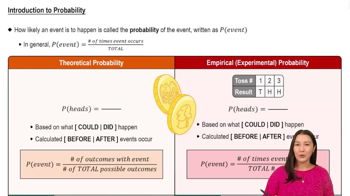
Probability of event A ≈ (number of times A occurs) / (number of trials).
When outcomes are equally likely, \(P(A) = \frac{\text{number of outcomes in A}}{\text{total number of outcomes}}\).
Probability estimated based on personal judgment or knowledge rather than exact calculation.
\(P(A \cup B) = P(A) + P(B) - P(A \cap B)\), the probability of A or B occurring.
\(P(A \cap B) = P(A) \cdot P(B|A) = P(B) \cdot P(A|B)\), the probability of both A and B occurring.
Events A and B are independent if \(P(B|A) = P(B)\) or equivalently \(P(A \cap B) = P(A) \cdot P(B)\).
Mutually exclusive events cannot occur together; independent events' occurrence does not affect each other.
Sampling where each selected item is returned before the next selection; selections are independent.
Sampling where selected items are not returned; selections are dependent.
\(P(A) = 1 - P(\overline{A})\), the probability of event A equals one minus the probability of its complement.
Probability of A given B has occurred: \(P(A|B) = \frac{P(A \cap B)}{P(B)}\).
Use \(P(A|B) = \frac{P(A \cap B)}{P(B)}\), considering the reduced sample space of B.
As the number of trials increases, the relative frequency of an event approaches its true probability.