Skip to main content
Introductory Statistics
My Course
Learn
Exam Prep
AI Tutor
Study Guides
Textbook Solutions
Flashcards
Explore
Try the app
My Course
Learn
Exam Prep
AI Tutor
Study Guides
Textbook Solutions
Flashcards
Explore
Try the app
Back
Estimating Parameters and Confidence Intervals in Statistics
You can tap to flip the card.
What is a parameter in statistics?
You can tap to flip the card.
👆
What is a parameter in statistics?
Parameter
is a numerical summary of a population.
Track progress
Control buttons has been changed to "navigation" mode.
1/20
Recommended videos
Guided course
04:46
Critical Values: z Scores
3189
views
61
rank
Guided course
06:33
Introduction to Confidence Intervals
4878
views
113
rank
Terms in this set (20)
Hide definitions
What is a parameter in statistics?
Parameter
is a numerical summary of a population.
What is a statistic in statistics?
Statistic
is any numerical measure computed from a subset of the population, typically a sample.
What is the difference between a point estimator and an interval estimator?
A
point estimator
estimates a parameter by a single value, while an
interval estimator
estimates by an interval of values (single value ± error).
What is the point estimate of the population mean (𝜇)?
The point estimate of the population mean 𝜇 is the sample mean \(\bar{x}\).
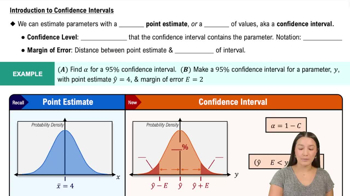
Define confidence interval (CI).
A
confidence interval
is a range of values obtained from a point estimate that likely contains the true population parameter.
What does the confidence level represent?
The
confidence level
is the probability that the true parameter lies within the confidence interval, denoted as (1 − 𝛼).
What are the most common confidence levels and their corresponding 𝛼 values?
Common confidence levels: 90% (𝛼=0.10), 95% (𝛼=0.05), 99% (𝛼=0.01).
How is the margin of error (E) related to the confidence interval?
The
margin of error
is half the length of the confidence interval and indicates the precision of the estimate.
Formula for a confidence interval for a population proportion 𝑝.
\(\hat{p} - z_{\alpha/2} \sqrt{\frac{\hat{p}(1-\hat{p})}{n}} < p < \hat{p} + z_{\alpha/2} \sqrt{\frac{\hat{p}(1-\hat{p})}{n}}\)
What are the requirements for estimating a population proportion?
Requirements: simple random sample, binomial conditions met, at least 5 successes and 5 failures (np≥5 and nq≥5).
How to find the point estimate and margin of error from a confidence interval?
Point estimate: average of upper and lower limits; Margin of error: half the difference between upper and lower limits.
Formula to determine sample size when estimating population proportion with known estimate 𝑝̂.
\(n = \left( \frac{Z_{\alpha/2}^2 \hat{p}(1-\hat{p})}{E^2} \right)\)
Formula to determine sample size when no estimate of 𝑝̂ is known.
\(n = \left( \frac{Z_{\alpha/2}^2 \times 0.25}{E^2} \right)\)
What is the best point estimate of the population mean 𝜇 when 𝜎 is unknown?
The sample mean \(\bar{x}\) is the best point estimate of 𝜇.
What distribution is used when estimating a population mean with unknown 𝜎?
The
Student's t-distribution
with (n-1) degrees of freedom is used.
Formula for the confidence interval for population mean 𝜇 with unknown 𝜎.
\(\bar{x} - t_{\alpha/2} \frac{s}{\sqrt{n}} < \mu < \bar{x} + t_{\alpha/2} \frac{s}{\sqrt{n}}\)
What are the conditions for using the t-distribution confidence interval?
Conditions: simple random sample, population normal or sample size n > 30.
How does the Student t-distribution compare to the standard normal distribution?
The t-distribution is symmetric like normal but has heavier tails; it approaches normal as sample size increases.
Formula to determine sample size for estimating a population mean 𝜇.
\(n = \left( \frac{Z_{\alpha/2} \sigma}{E} \right)^2\)
How does increasing the confidence level affect the confidence interval width?
Increasing confidence level increases the width of the confidence interval, making it less precise but more reliable.
 BackBack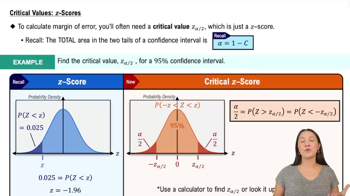
 04:46
04:46