 Back
BackFundamentals of Statistics
 04:24
04:24

Terms in this set (27)
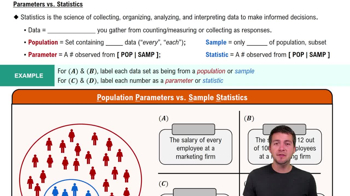
Statistics is the science of collecting, organizing, analyzing, and interpreting data to make decisions.
Data consist of information coming from observations, counts, measurements, or responses.
A population is the collection of all outcomes, responses, measurements, or counts that are of interest in a study.
A sample is a subset or part of a population used to gain information about the population.
Random sampling ensures the sample is representative of the population, allowing valid conclusions about the population.
A parameter is a numerical description of a population characteristic.
A statistic is a numerical description of a sample characteristic.
A parameter is constant for a population, while a statistic can vary from sample to sample.
Descriptive statistics involves organizing, summarizing, and displaying data.
Inferential statistics uses sample data to draw conclusions about a population.
Reporting that 18% of adults from households earning less than \$30,000 do not use the Internet is an example of descriptive statistics.
Concluding that lower-income households have less Internet access based on a sample is an example of inferential statistics.
A census is data collected from every member of a population.
Because populations are usually large, collecting data from every member is often impractical or impossible.
Match the first letters: Population Parameter and Sample Statistic.
The census data determine congressional seats and distribution of public funds.
The cost has escalated from about \$91.5 million in 1950 to \$15.6 billion in 2020.
A population parameter describes the entire population, while a sample statistic describes only the sample and may vary.
The average SAT math score of an entire freshman class is a population parameter.
The average leisure time from a survey of 9400 individuals is a sample statistic.
Descriptive statistics and inferential statistics.
Probability is a basic tool used in inferential statistics to draw conclusions about populations from samples.
To use sample data to make generalizations or predictions about a population.
To summarize and describe the main features of a data set.
Inappropriate methods can lead to biased samples that do not represent the population, invalidating conclusions.
The 751 employees surveyed out of all U.S. employees represent the sample.
All teens in the United States are the population.