 Back
BackIntroduction to Statistics - Key Concepts
 04:24
04:24

Terms in this set (20)
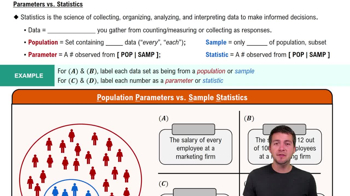
Statistics is the science of collecting, organizing, analyzing, and interpreting data to make informed decisions.
Population is the entire set of data or all individuals of interest. A sample is a subset of the population.
A parameter is a numerical value describing a population, while a statistic describes a sample.
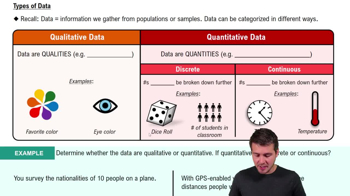
Qualitative data are non-numerical and describe qualities or categories, such as eye color or favorite music genre.
Quantitative data are numerical. Discrete data can be counted and are whole numbers; continuous data can take any value within a range.
Qualitative: Favorite color. Quantitative discrete: Number of students in a class. Quantitative continuous: Temperature.
Nominal, Ordinal, Interval, and Ratio levels classify data based on order, meaningful differences, and presence of a true zero.
Nominal data are categories or labels with no order or ranking, e.g., hair color.
Ordinal data have a meaningful order but differences are not meaningful, e.g., letter grades.
Interval data have meaningful differences but no true zero, e.g., temperature in °F.
Ratio data have a true zero and meaningful ratios, e.g., height or weight.
An experiment applies a treatment and can imply causation; an observational study only measures without intervention and cannot imply causation.
SRS means every subject and every possible group has an equal chance of being selected.
A representative sample reflects the characteristics of the population proportionally.
Systematic sampling selects every kth subject from a list or sequence.
Cluster sampling divides the population into groups (clusters) and randomly selects entire clusters.
Stratified sampling divides the population into strata with similar characteristics, then randomly samples from each stratum.
Because temperature in °F is interval level data with no true zero, ratios like 'twice as hot' are meaningless.
No, observational studies do not control variables, so causation cannot be assumed.
Yes, because experiments apply treatments and control variables, causation can be inferred.