Skip to main content
Introductory Statistics
My Course
Learn
Exam Prep
AI Tutor
Study Guides
Textbook Solutions
Flashcards
Explore
Try the app
My Course
Learn
Exam Prep
AI Tutor
Study Guides
Textbook Solutions
Flashcards
Explore
Try the app
Back
Introductory Statistics: Probability Concepts
You can tap to flip the card.
What is a priori probability?
You can tap to flip the card.
👆
What is a priori probability?
A priori probability is based on prior knowledge of the process involved, not on observed data.
Track progress
Control buttons has been changed to "navigation" mode.
1/11
Recommended videos
Guided course
5:37
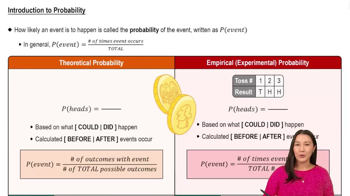
Introduction to Probability
11834
views
457
rank
1
comments
Terms in this set (11)
Hide definitions
What is a priori probability?
A priori probability is based on prior knowledge of the process involved, not on observed data.
Example of a priori probability with a deck of cards
The probability of selecting a black card is \(\frac{26}{52}\) = 0.50, since there are 26 black cards out of 52 total.
What is empirical probability?
Empirical probability is based on observed data or experiments, not on prior knowledge.
How are empirical probabilities often generated?
Empirical probabilities are often generated using surveys or observed data.
What is subjective probability?
Subjective probability varies from person to person based on personal judgment or opinion.
Example of subjective probability
A development team may assign a 0.60 chance of success to a product, while the company president may assign 0.30.
Define a simple event
A simple event is described by a single characteristic, such as selecting a day in January from all days in 2014.
Define a joint event
A joint event has two or more characteristics, e.g., a day in January that is also a Wednesday.
What is the complement of an event A?
The complement of event A includes all outcomes that are not part of A.
Example of a complement event
All days from 2014 that are not in January form the complement of the event 'day in January.'
What is a sample space?
The sample space is the collection of all possible outcomes or events.
 BackBack
 5:37
