 Back
Introductory Statistics: Probability Concepts and Counting
 5:37

Terms in this set (20)
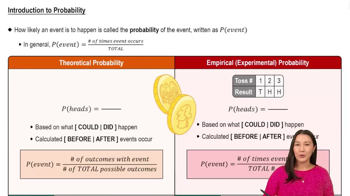
Probability is how often something occurs or is expected to occur.
It helps make decisions about populations, often using the Rare Event Rule.
If the probability of an observed event is extremely small under an assumption, the assumption is probably not correct. Such an event is called statistically significant.
A tree diagram helps find the sample space by showing all possible outcomes of a procedure.
Multiply the number of possible outcomes for each part of a procedure to find the total possible outcomes.
The sample space is {1, 2, 3, 4, 5, 6}, representing all possible outcomes.
The sample space is {HH, HT, TH, TT}, representing all possible outcomes.
The factorial, denoted \(!\), is the product of decreasing positive whole numbers, e.g., \(4! = 4 \cdot 3 \cdot 2 \cdot 1 = 24\).
By definition, \(0! = 1\).
\(P(A) = \frac{\text{number of occurrences of A}}{\text{total number of outcomes}}\)
Probability values are between 0 and 1, inclusive. 0 means impossible, 1 means certain.
Classical probability assumes each event has an equal chance of occurring and is calculated without producing results.
Relative frequency probability is calculated from recorded data of a procedure and is an approximation.
Use the Fundamental Counting Principle: 2 (coin) × 3 (spinner) × 2 (coin) = 12 possible outcomes.
Multiply: 4 × 3 × 3 = 36 possible outfits.
Calculate \(5! = 120\) possible passwords.
There are \(6! = 720\) ways to arrange the books.
It means the event is very unlikely to happen by chance, indicating the assumption may be incorrect.
A simple event is an event that cannot be broken down into simpler components.
The sample space is the set of all possible outcomes of a procedure.