What is the response variable in the Employee Salary Analysis dataset?
The response variable is salary.
Which variables are used as predictors in the multiple regression model for salary?
The predictors are years of experience and a dummy variable for gender (0 for female, 1 for male).
What does the dummy variable for gender represent in the regression model?
It represents gender as a numeric variable: 0 for female and 1 for male.
How is the multiple regression equation structured with experience and gender dummy variable?
The equation is \(\hat{Salary} = b_0 + b_1(Experience) + b_2(Gender)\), where b_0 is intercept, b_1 is experience coefficient, and b_2 is gender coefficient.
How do you predict salary for a female employee with 10 years of experience using the regression equation?
Substitute Gender = 0 and Experience = 10 into the equation: \(\hat{Salary} = b_0 + b_1 \times 10 + b_2 \times 0\).
How do you predict salary for a male employee with 10 years of experience using the regression equation?
Substitute Gender = 1 and Experience = 10 into the equation: \(\hat{Salary} = b_0 + b_1 \times 10 + b_2 \times 1\).
What does a significant coefficient for the gender dummy variable indicate?
It indicates that gender has a significant effect on salary after controlling for experience.
What is the purpose of including a dummy variable in regression analysis?
To quantify the effect of a categorical variable (like gender) on the response variable.
Why is experience included as a predictor in the salary regression model?
Because years of experience is expected to influence salary.
What is the interpretation of the intercept b_0 in the regression equation?
It represents the predicted salary for a female employee with zero years of experience (when Gender=0 and Experience=0).
How can you test if gender has a significant effect on salary?
By checking if the coefficient b_2 for the gender dummy variable is statistically significant (e.g., p-value < 0.05).
What does the coefficient b_1 represent in the regression model?
The change in predicted salary for each additional year of experience, holding gender constant.
If the gender coefficient b_2 is positive and significant, what does it imply?
It implies that male employees earn more than female employees with the same experience.
If the gender coefficient b_2 is not significant, what does that imply?
It implies that gender does not have a significant effect on salary after accounting for experience.
What is the role of multiple regression in this salary analysis?
To model salary as a function of multiple predictors (experience and gender) simultaneously.
How do you interpret the predicted salary difference between male and female employees with the same experience?
It equals the gender coefficient b_2 in the regression equation.
Why is it important to include both experience and gender in the regression model?
To control for experience when assessing the effect of gender on salary.
What assumptions underlie the multiple regression model used here?
Linearity, independence, homoscedasticity, normality of errors, and correct model specification.
What is the meaning of the term 'response variable' in regression?
The variable being predicted or explained, here it is salary.
What is the meaning of 'predictor variable' in regression?
An independent variable used to predict the response, here experience and gender dummy.
 Back
Back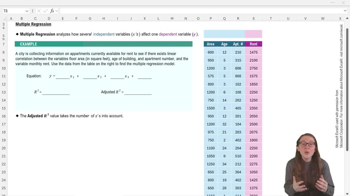
 06:37
06:37