 Back
BackStatistics Final Exam Key Concepts
 05:24
05:24
Terms in this set (23)
Explanatory variable explains or predicts changes; response variable is the outcome measured.
Outliers are extreme values; influential points strongly affect regression results. Both identified by residuals and leverage.
Use Pearson's r for linear relationships; Spearman's rho for monotonic but non-linear; choose based on scatter plot pattern.
Correlation coefficient measures strength/direction; critical values determine significance thresholds for hypothesis tests.
Check scatter plot pattern and test if correlation coefficient is significantly different from zero using hypothesis test.
Use regression equation \(\hat{y} = b_0 + b_1 x\) to predict y from x.
\(R^2\) indicates the proportion of variance in response variable explained by explanatory variable.
Tests if two population means differ. Null: means equal; alternative: means differ. Uses t-distribution or z-distribution depending on data.
Regions defined by critical values where null hypothesis is rejected or not, based on test statistic and significance level.
Based on whether null is rejected or not, conclude if there is sufficient evidence to support alternative hypothesis.
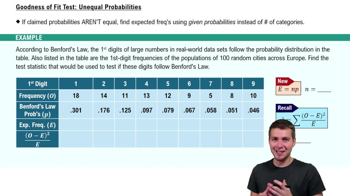
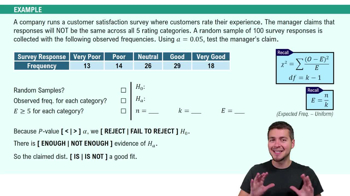
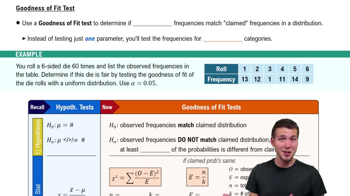
Determine if prompt fits Difference Between Means, Goodness of Fit, or ANOVA by data type and question focus.
Type I: Rejecting true null. Type II: Failing to reject false null. Errors depend on hypothesis and test design.
Use z-scores with Standard Normal, t-scores with Student-t, and chi-square scores with Chi-Square distribution depending on test.
Wider intervals mean less precision; affected by sample size, variability, and confidence level.
Interval likely contains the true population parameter with specified confidence (e.g., 95%).
Use Standard Normal when population standard deviation known; Student-t when unknown and sample size small.
Standard Normal is Normal with mean 0 and SD 1; Normal can have any mean and SD.
Allows approximation of sampling distribution of sample mean to Normal for large samples regardless of population distribution.
Discrete: countable values; Continuous: any value in interval. Different graph types represent each.
Probabilities sum to 1; each probability between 0 and 1; describes all possible outcomes.
Binomial: fixed trials, two outcomes; Poisson: counts events over interval, no fixed trials.
Summarize data by showing frequency of values or categories to understand data distribution.
Qualitative: categorical data; Quantitative: numerical data. Different graphs used for each.