 Back
BackStatistics Key Concepts and Definitions
 5:14
5:14
Terms in this set (29)
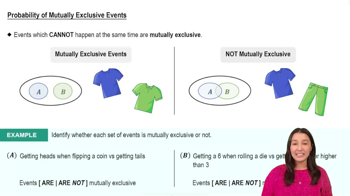
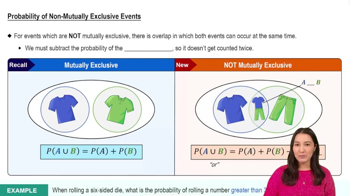
The rule to find the probability that one or the other of two events occurs. For mutually exclusive events, \(P(A \cup B) = P(A) + P(B)\).
A systematic error that causes a sample statistic to differ from the population parameter in a consistent way.
A scenario with fixed number of independent trials, each with two possible outcomes and constant probability of success.
The probability distribution of the number of successes in a fixed number of independent Bernoulli trials.
A random variable that counts the number of successes in a binomial setting.
A technique in experiments where subjects or researchers do not know which treatment was assigned to reduce bias.
An experimental design that groups subjects with similar characteristics into blocks to reduce variability.
States that the sampling distribution of the sample mean approaches a normal distribution as sample size increases, regardless of population distribution.
A distribution used for tests of independence and goodness-of-fit, based on the sum of squared standard normal variables.
A measure of how observed counts differ from expected counts, calculated as \(\sum \frac{(O - E)^2}{E}\).
Goodness-of-fit test to determine if observed categorical data matches an expected distribution.
A sampling method where the population is divided into clusters, some clusters are randomly selected, and all members in chosen clusters are sampled.
Denoted \(R^2\), it measures the proportion of variance in the response variable explained by the explanatory variable.
The probability of event A given event B has occurred, \(P(A|B) = \frac{P(A \cap B)}{P(B)}\).
An interval estimate that likely contains the population mean with a specified confidence level.
An interval estimate that likely contains the population proportion with a specified confidence level.
A measure of the strength and direction of a linear relationship between two quantitative variables, ranging from -1 to 1.
A random variable that takes on countable values, often integers.
In a normal distribution, about 68% of data falls within 1 standard deviation, 95% within 2, and 99.7% within 3.
As the number of trials increases, the sample mean approaches the population mean.
The maximum expected difference between the sample statistic and the population parameter in a confidence interval.
A symmetric, bell-shaped distribution defined by its mean and standard deviation.
The probability of obtaining a test statistic at least as extreme as the one observed, assuming the null hypothesis is true.
A variable whose value depends on the outcome of a random phenomenon.
The threshold probability for rejecting the null hypothesis, commonly denoted \(\alpha\).
A measure of the spread or variability of a set of data around the mean.
Rejecting the null hypothesis when it is actually true.
Failing to reject the null hypothesis when it is actually false.
The number of standard deviations a data point is from the mean, calculated as \(z = \frac{x - \mu}{\sigma}\).