Back

Statistics Key Concepts and Problems

Control buttons has been changed to "navigation" mode.
1/29
  • What does a confidence interval suggest about the difference in two population means?

    It estimates the range of values within which the true difference between the two population means likely falls, with a given level of confidence.
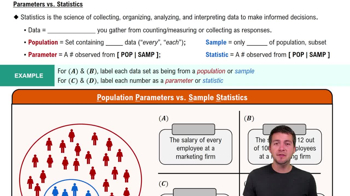
  • Define outlier, skewed, parameter, and statistic.

    Outlier: A data point far from others.
    Skewed: Asymmetric data distribution.
    Parameter: A numerical characteristic of a population.
    Statistic: A numerical characteristic of a sample.
  • What is the null hypothesis in hypothesis testing?

    The null hypothesis is a statement of no effect or no difference, representing the status quo or default assumption.
  • What is the alternative hypothesis?

    The alternative hypothesis is the claim that contradicts the null, representing an effect or difference to be tested.
  • Which value is NOT part of the 5-number summary?

    The 5-number summary includes minimum, first quartile, median, third quartile, and maximum; the mean is NOT part of it.
  • How to find the z-score of a data value?

    Subtract the mean from the data value and divide by the standard deviation: \(z=\frac{x-\mu}{\sigma}\).
  • What is empirical probability?

    Probability based on observed data or experiments rather than theoretical calculation.
  • How to find class width in a grouped frequency distribution?

    Subtract the lower boundary of one class from the lower boundary of the next class.
  • What conditions define a binomial distribution?

    Fixed number of trials, two outcomes per trial, constant probability, and independent trials.
  • Define sampling distribution, normal distribution, uniform distribution, and t distribution.

    Sampling distribution: Distribution of a statistic over many samples.
    Normal distribution: Symmetric, bell-shaped.
    Uniform distribution: Equal probability over an interval.
    t distribution: Similar to normal but with heavier tails.
  • What is cluster sampling?

    Sampling method where the population is divided into clusters, some clusters are randomly selected, and all members in chosen clusters are sampled.
  • What is a simple random sample?

    A sample where every member of the population has an equal chance of being selected.
  • What is the margin of error?

    The maximum expected difference between the sample statistic and the true population parameter.
  • Define Type I and Type II errors.

    Type I error: Rejecting a true null hypothesis.
    Type II error: Failing to reject a false null hypothesis.
  • What is the difference between subjective probability and sampling error?

    Subjective probability: Based on personal judgment.
    Sampling error: Difference between sample statistic and population parameter due to chance.
  • What is the sample space in probability?

    The set of all possible outcomes of an experiment.
  • Define independent events and mutually exclusive events.

    Independent events: Occurrence of one does not affect the other.
    Mutually exclusive events: Cannot occur at the same time.
  • How to find the median of a data set?

    Order the data and select the middle value; if even number of values, average the two middle values.
  • How to find the standard deviation from variance?

    Take the square root of the variance.
  • What is the fundamental counting principle?

    If one event can occur in m ways and another in n ways, total ways for both is m × n.
  • When is it appropriate to use a regression line to predict y values?

    When there is a strong linear relationship between x and y and the data fits the model assumptions.
  • What is a point estimate?

    A single value used to estimate a population parameter.
  • What is a random variable?

    A variable whose values depend on the outcomes of a random phenomenon.
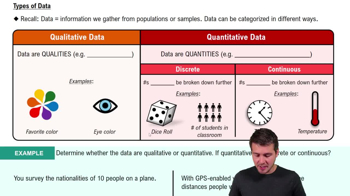
  • What is the difference between continuous and discrete data?

    Continuous data: Can take any value in an interval.
    Discrete data: Countable values.
  • What is the expected value (mean) of a probability distribution?

    The weighted average of all possible values, weighted by their probabilities.
  • What is the difference between combinations and permutations?

    Combinations: Order does not matter.
    Permutations: Order matters.
  • What is a P value in hypothesis testing?

    The probability of obtaining a test statistic at least as extreme as the one observed, assuming the null hypothesis is true.
  • What is a census?

    A survey that collects data from every member of the population.
  • What is a sampling error?

    The difference between a sample statistic and the actual population parameter caused by chance.