 Back
Types of Data - Introductory Statistics
 06:52

Terms in this set (20)
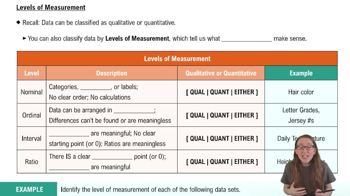
Qualitative (categorical) and quantitative (numerical) data.
Data that describes categories or qualities, such as colors or labels, without numerical meaning.
Data that represents numerical values and can be measured or counted.
Nominal and ordinal data.
Qualitative data with categories that have no natural order, e.g., gender or blood type.
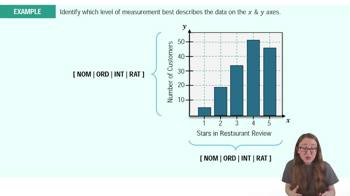
Qualitative data with categories that have a meaningful order but no fixed interval, e.g., rankings or satisfaction levels.
Discrete and continuous data.
Quantitative data that can take only specific values, often counts, e.g., number of students.
Quantitative data that can take any value within a range, e.g., height or temperature.
Examples include eye color, types of fruit, or car brands.
Examples include class rankings, satisfaction ratings, or levels of education.
Examples include number of pets, number of cars, or number of phone calls.
Examples include weight, time, or temperature measurements.
Because the type of data determines the appropriate statistical methods and visualizations to use.
Ordinal qualitative data, since it has a meaningful order but intervals are not equal.
Discrete data, because goals are counted in whole numbers.
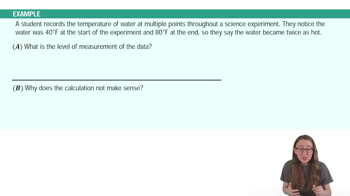
Continuous data, because temperature can take any value within a range.
Nominal qualitative data, as categories have no order.
Quantitative discrete if age is counted in whole years; continuous if measured precisely.
Qualitative data often use bar charts or pie charts; quantitative data use histograms or scatterplots.