Skip to main content
Trigonometry
My Course
Learn
Exam Prep
AI Tutor
Study Guides
Textbook Solutions
Flashcards
Explore
Try the app
My Course
Learn
Exam Prep
AI Tutor
Study Guides
Textbook Solutions
Flashcards
Explore
Try the app
Back
Polar Coordinate System definitions
You can tap to flip the card.
Polar Coordinate System
You can tap to flip the card.
👆
Polar Coordinate System
A method for locating points using a distance from a central pole and an angle from a reference axis.
Track progress
Control buttons has been changed to "navigation" mode.
1/15
Related flashcards
Related practice
Recommended videos
Polar Coordinate System quiz #1
Polar Coordinate System
12 Terms
Polar Coordinate System
9. Polar Equations
7 problems
Topic
Patrick
Convert Points Between Polar and Rectangular Coordinates
9. Polar Equations
3 problems
Topic
ErnestBlazevic
9. Polar Equations
4 topics
10 problems
Chapter
Patrick
Guided course
05:32
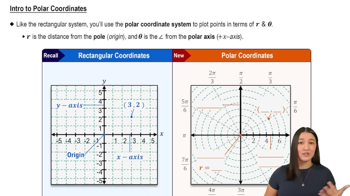
Intro to Polar Coordinates
1060
views
9
rank
Guided course
6:02
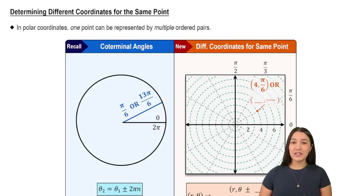
Determining Different Coordinates for the Same Point
901
views
4
rank
Guided course
02:13
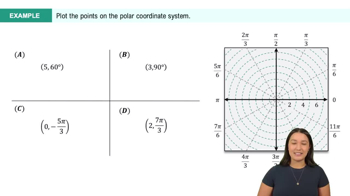
Intro to Polar Coordinates Example 1
956
views
4
rank
Terms in this set (15)
Hide definitions
Polar Coordinate System
A method for locating points using a distance from a central pole and an angle from a reference axis.
Pole
The central reference point in this system, corresponding to the origin where the radius equals zero.
Polar Axis
The fixed line from the pole, serving as the starting direction for measuring angles.
Radius
The distance from the pole to a point, represented by the variable r in ordered pairs.
Theta
The angle measured from the polar axis, indicating the direction of a point from the pole.
Ordered Pair
A set of values (r, theta) specifying a point's location by distance and angle in this system.
Coterminal Angles
Angles differing by multiples of 2π, which point to the same location in this coordinate system.
Reflection
A transformation over the pole or axis, used when negative values for radius or angle are involved.
Rectangular Coordinates
A system using x and y values to locate points, contrasted with the polar method.
Unit Circle
A circle with radius one, used as a reference for measuring angles and understanding this system.
Quadrant
A region of the plane divided by axes, relevant for interpreting the location of points.
Interval
A specified range for angle or radius values, often used to restrict possible ordered pairs.
Positive Radius
A value for r indicating movement away from the pole in the direction of the angle.
Negative Radius
A value for r indicating movement away from the pole in the direction opposite to the angle.
Multiple Representations
The concept that a single point can be described by various ordered pairs due to angle and radius manipulations.
 BackBack

 05:32
05:32