Back

Rationalizing Denominators definitions

Control buttons has been changed to "navigation" mode.
1/15
  • Radical

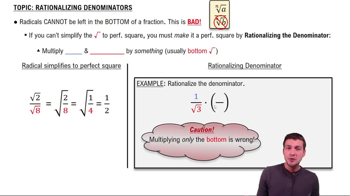
    An expression involving a root, often a square root, that cannot always be simplified to a rational number.
  • Denominator

    The lower part of a fraction, which must not contain a radical for proper mathematical form.
  • Rational Number

    A value expressible as a fraction of integers, free from radicals in the denominator.
  • Perfect Square

    A number whose square root yields a whole number, allowing radicals to be removed easily.
  • Numerator

    The upper part of a fraction, which can contain radicals without violating mathematical conventions.
  • Conjugate

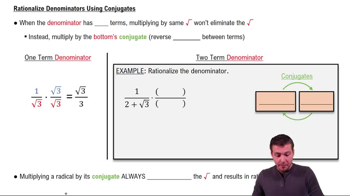
    A binomial formed by reversing the sign between two terms, used to eliminate radicals in denominators.
  • Binomial

    An algebraic expression with two terms, often appearing in denominators requiring rationalization.
  • Difference of Squares

    A result from multiplying conjugates, producing a rational number by eliminating radicals.
  • Fraction

    A mathematical expression representing division, where radicals must not remain in the denominator.
  • Expression

    A combination of numbers, variables, and operations, often requiring simplification for proper form.
  • Square Root

    A radical representing a value that, when multiplied by itself, gives the original number.
  • Simplification

    The process of reducing an expression to its most basic form, often by removing radicals from denominators.
  • Mathematical Convention

    A standard practice, such as not leaving radicals in denominators, to ensure clarity and correctness.
  • Equivalent Expression

    Two forms of an expression that yield the same value, even after rationalizing the denominator.
  • Foil

    A method for multiplying binomials, used when rationalizing denominators with two terms.