Back

Rationalizing Denominators quiz

Control buttons has been changed to "navigation" mode.
1/15
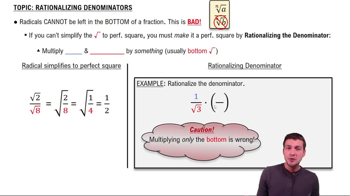
  • What does it mean to rationalize the denominator?

    It means to eliminate any radicals from the denominator so that it becomes a rational number.
  • Why can't you leave a radical in the denominator of a fraction?

    Because it is a mathematical convention to have denominators as rational numbers, not radicals.
  • What do you multiply by to rationalize a denominator with a single radical term?

    You multiply both the numerator and denominator by the same radical present in the denominator.
  • What is the result of multiplying radical 3 by radical 3?

    The result is 3, because the product of a square root with itself is the number under the root.
  • If you have 1 over radical 3, what do you multiply by to rationalize the denominator?

    You multiply both the numerator and denominator by radical 3.
  • What is the simplified form of 1 over radical 3 after rationalizing the denominator?

    It becomes radical 3 over 3.
  • Does rationalizing the denominator change the value of the expression?

    No, because you are multiplying by a form of 1, so the value stays the same.
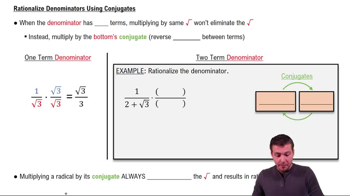
  • What do you do if the denominator is a binomial with a radical, like 2 + radical 3?

    You multiply both the numerator and denominator by the conjugate of the denominator.
  • How do you find the conjugate of a binomial like 2 + radical 3?

    You reverse the sign between the two terms, so the conjugate is 2 - radical 3.
  • Why does multiplying by the conjugate eliminate the radical in the denominator?

    Because it creates a difference of squares, which removes the radical.
  • What is the general formula for the conjugate of a + radical b?

    The conjugate is a - radical b.
  • What happens to the numerator when you multiply by the conjugate?

    You multiply the numerator by the same conjugate as the denominator.
  • What is the result of multiplying (2 + radical 3) by (2 - radical 3)?

    The result is 4 - 3, which equals 1.
  • When rationalizing, why must you multiply both the numerator and denominator by the same value?

    To ensure the value of the expression does not change, since you are multiplying by 1.
  • Summarize the two main methods for rationalizing denominators.

    Multiply by the radical for single-term denominators, and by the conjugate for two-term denominators.