Skip to main content
Trigonometry
My Course
Learn
Exam Prep
AI Tutor
Study Guides
Textbook Solutions
Flashcards
Explore
Try the app
My Course
Learn
Exam Prep
AI Tutor
Study Guides
Textbook Solutions
Flashcards
Explore
Try the app
Back
Solving Linear Equations definitions
You can tap to flip the card.
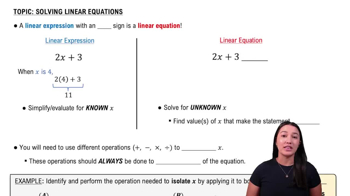
Linear Equation
You can tap to flip the card.
👆
Linear Equation
A mathematical statement equating a linear expression to another value, allowing for the determination of unknowns.
Track progress
Control buttons has been changed to "navigation" mode.
1/15
Related flashcards
Related practice
Recommended videos
Solving Linear Equations quiz #1
Solving Linear Equations
10 Terms
Solving Linear Equations
0. Review of College Algebra
5 problems
Topic
Patrick
Solving Quadratic Equations
0. Review of College Algebra
1 problem
Topic
0. Review of College Algebra - Part 1 of 2
4 topics
9 problems
Chapter
Patrick
0. Review of College Algebra - Part 2 of 2
5 topics
10 problems
Chapter
Patrick
Guided course
7:48
Solving Linear Equations
1530
views
22
rank
Guided course
4:02
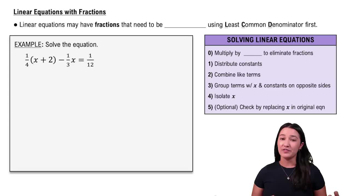
Solving Linear Equations with Fractions
1076
views
12
rank
Guided course
6:00
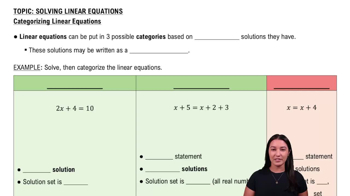
Categorizing Linear Equations
1005
views
10
rank
Terms in this set (15)
Hide definitions
Linear Equation
A mathematical statement equating a linear expression to another value, allowing for the determination of unknowns.
Linear Expression
A combination of numbers, variables, and operations without an equal sign, forming the basis for equations.
Variable
A symbol representing an unknown value in an equation, commonly denoted as x.
Constant
A fixed numerical value within an equation or expression, unaffected by variable changes.
Opposite Operation
A mathematical process used to reverse another operation, such as subtraction for addition or division for multiplication.
Isolating x
The process of manipulating an equation to have the variable x alone on one side, revealing its value.
Least Common Denominator
The smallest shared multiple of denominators in an equation, used to eliminate fractions efficiently.
Solution Set
A collection of values that satisfy an equation, often written in curly brackets or set notation.
Conditional Equation
A linear equation true only for a specific value of the variable, resulting in a single solution.
Identity Equation
A linear equation always true for any value of the variable, yielding infinite solutions.
Inconsistent Equation
A linear equation resulting in a false statement, indicating no possible solution exists.
Empty Set
A solution set containing no elements, denoted by a zero with a slash, representing no valid solutions.
Distributive Property
A rule allowing multiplication across terms within parentheses, simplifying equations before solving.
Combining Like Terms
The process of merging terms with identical variables or exponents to simplify an equation.
Root
A value of the variable that makes the equation true, synonymous with solution or answer.
 BackBack
 7:48
7:48