Skip to main content
Trigonometry
My Course
Learn
Exam Prep
AI Tutor
Study Guides
Textbook Solutions
Flashcards
Explore
Try the app
My Course
Learn
Exam Prep
AI Tutor
Study Guides
Textbook Solutions
Flashcards
Explore
Try the app
Back
Solving Quadratic Equations quiz
You can tap to flip the card.
What is the standard form of a quadratic equation?
You can tap to flip the card.
👆
What is the standard form of a quadratic equation?
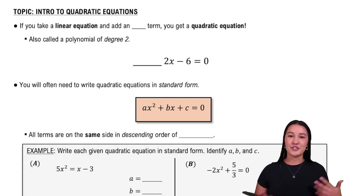
The standard form is ax² + bx + c = 0, where a, b, and c are constants.
Track progress
Control buttons has been changed to "navigation" mode.
1/15
Related flashcards
Related practice
Recommended videos
Solving Quadratic Equations definitions
Solving Quadratic Equations
15 Terms
Solving Quadratic Equations
0. Review of College Algebra
1 problem
Topic
Complex Numbers
0. Review of College Algebra
3 problems
Topic
ErnestBlazevic
0. Review of College Algebra - Part 1 of 2
4 topics
9 problems
Chapter
Patrick
0. Review of College Algebra - Part 2 of 2
5 topics
10 problems
Chapter
Patrick
Guided course
6:24
Solving Quadratic Equations by Completing the Square
834
views
2
rank
Guided course
6:08
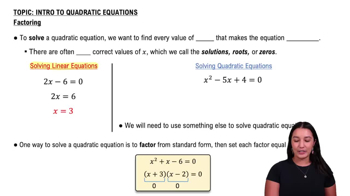
Factoring
834
views
7
rank
Guided course
5:35
Introduction to Quadratic Equations
940
views
6
rank
Terms in this set (15)
Hide definitions
What is the standard form of a quadratic equation?
The standard form is ax² + bx + c = 0, where a, b, and c are constants.
How do you identify the coefficients a, b, and c in a quadratic equation?
a is the coefficient of x², b is the coefficient of x, and c is the constant term.
What is the first step when solving a quadratic equation by factoring?
Write the equation in standard form with all terms on one side and in descending order of power.
After factoring a quadratic equation, what do you do to find the solutions?
Set each factor equal to zero and solve for x.
When is factoring a good method for solving quadratic equations?
Factoring is effective when the equation has obvious factors or when the constant term c is zero.
What is the square root property used for in solving quadratic equations?
It is used when the equation is in the form (x + a)² = k or when there is no x term.
What must you remember to include when taking the square root of both sides of an equation?
You must include both the positive and negative square roots (±).
What type of solutions might you get when using the square root property?
You may get whole numbers, fractions, radicals, or complex (imaginary) roots.
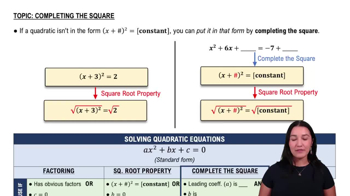
What is the process of completing the square?
It involves rewriting the equation to isolate the squared term and adding (b/2)² to both sides.
When is completing the square especially useful?
It is especially useful when the leading coefficient a is 1 and b is even.
What is the quadratic formula?
The quadratic formula is x = (-b ± √(b² - 4ac)) / (2a).
When should you use the quadratic formula?
You can use it for any quadratic equation, especially when other methods are not easily applicable.
What does the discriminant (b² - 4ac) tell you about the solutions of a quadratic equation?
If the discriminant is positive, there are two real solutions; if zero, one real solution; if negative, two complex solutions.
What is a clue that a quadratic equation will have complex solutions?
If a and c have the same sign in the standard form, the equation will have complex solutions.
Why is it important to check your solutions by plugging them back into the original equation?
Checking ensures that the solutions make the original equation true and verifies your work.
 BackBack

 6:24
6:24