Pearson+ LogoPearson+ Logo

Sum and Difference Identities quiz #1 Flashcards

Back
Sum and Difference Identities quiz #1
Control buttons has been changed to "navigation" mode.
1/10
  • How can you use sum and difference identities to find the exact value of sin(75°)?

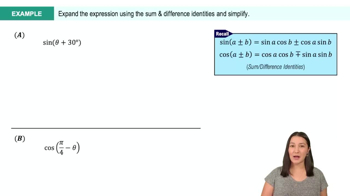
    To find sin(75°), express 75° as the sum of two known angles, such as 45° and 30°. Using the sum identity: sin(75°) = sin(45° + 30°) = sin(45°)cos(30°) + cos(45°)sin(30°). Substitute known values: sin(45°) = √2/2, cos(30°) = √3/2, cos(45°) = √2/2, sin(30°) = 1/2. Therefore, sin(75°) = (√2/2)(√3/2) + (√2/2)(1/2) = (√6/4) + (√2/4) = (√6 + √2)/4.
  • How can you use sum and difference identities to find the exact value of sin(165°)?

    Express 165° as the sum of two known angles, such as 120° and 45°. Using the sum identity: sin(165°) = sin(120° + 45°) = sin(120°)cos(45°) + cos(120°)sin(45°). Substitute known values: sin(120°) = √3/2, cos(45°) = √2/2, cos(120°) = -1/2, sin(45°) = √2/2. Therefore, sin(165°) = (√3/2)(√2/2) + (-1/2)(√2/2) = (√6/4) - (√2/4) = (√6 - √2)/4.
  • How can you use sum and difference identities to find the exact value of sin(105°)?

    Express 105° as the sum of two known angles, such as 60° and 45°. Using the sum identity: sin(105°) = sin(60° + 45°) = sin(60°)cos(45°) + cos(60°)sin(45°). Substitute known values: sin(60°) = √3/2, cos(45°) = √2/2, cos(60°) = 1/2, sin(45°) = √2/2. Therefore, sin(105°) = (√3/2)(√2/2) + (1/2)(√2/2) = (√6/4) + (√2/4) = (√6 + √2)/4.
  • How can you use sum and difference identities to find the exact value of cos(15°)?

    Express 15° as the difference of two known angles, such as 45° and 30°. Using the difference identity: cos(15°) = cos(45° - 30°) = cos(45°)cos(30°) + sin(45°)sin(30°). Substitute known values: cos(45°) = √2/2, cos(30°) = √3/2, sin(45°) = √2/2, sin(30°) = 1/2. Therefore, cos(15°) = (√2/2)(√3/2) + (√2/2)(1/2) = (√6/4) + (√2/4) = (√6 + √2)/4.
  • What is the sum identity for tangent when expanding tan(a + b)?

    The sum identity for tangent is tan(a + b) = (tan a + tan b) / (1 - tan a tan b). This formula allows you to expand the tangent of a sum into terms involving tan a and tan b.
  • When using the tangent sum or difference identity, what should you do if one of the tangent values is undefined?

    If one of the tangent values is undefined, rewrite the expression in terms of sine and cosine instead. This avoids undefined values and allows you to use the sum and difference identities for sine and cosine.
  • Why is it important to pay attention to the signs of side lengths when constructing right triangles in different quadrants?

    The signs of side lengths depend on the quadrant in which the angle lies, affecting the values of sine and cosine. Assigning the correct sign ensures accurate calculation of trigonometric values.
  • What is the first step when asked to find the sine or cosine of a sum or difference given only some trig values and quadrant information?

    The first step is to expand the relevant sum or difference identity and identify any unknown trig values. This sets up the problem for finding missing values using triangles.
  • How do you find missing side lengths in a right triangle when given one side and the hypotenuse?

    Use the Pythagorean theorem to solve for the missing side. For example, if you know the adjacent side and hypotenuse, calculate the opposite side as sqrt(hypotenuse^2 - adjacent^2).
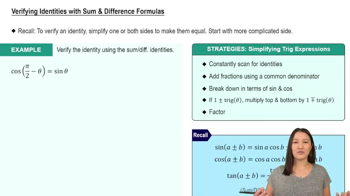
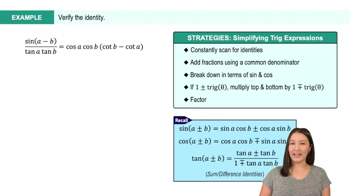
  • What strategy should you use when verifying a trigonometric identity involving a sum or difference in the argument?

    Start by simplifying the more complicated side using the appropriate sum or difference identity. This helps transform the expression into a form that matches the other side of the equation.