Skip to main content
Trigonometry
My Course
Learn
Exam Prep
AI Tutor
Study Guides
Textbook Solutions
Flashcards
Explore
Try the app
My Course
Learn
Exam Prep
AI Tutor
Study Guides
Textbook Solutions
Flashcards
Explore
Try the app
Back
Transformations definitions
You can tap to flip the card.
Transformation
You can tap to flip the card.
👆
Transformation
Alters a function's graph or equation, changing its position or shape through specific manipulations.
Track progress
Control buttons has been changed to "navigation" mode.
1/15
Related flashcards
Related practice
Recommended videos
Transformations quiz #1
Transformations
23 Terms
Transformations
0. Review of College Algebra
3 problems
Topic
ErnestBlazevic
Asymptotes
0. Review of College Algebra
3 problems
Topic
0. Review of College Algebra - Part 1 of 2
4 topics
9 problems
Chapter
Patrick
0. Review of College Algebra - Part 2 of 2
5 topics
10 problems
Chapter
Patrick
Guided course
5:34
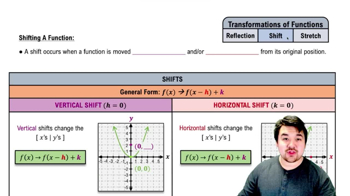
Shifting A Functions
650
views
2
rank
Guided course
6:02
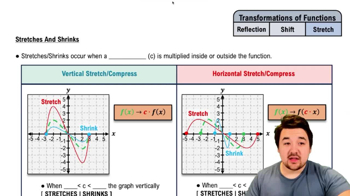
Stretches and Shrinks of Functions
752
views
5
rank
Guided course
4:25
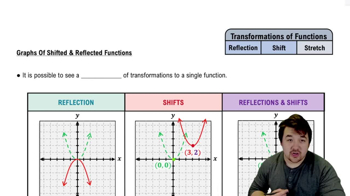
Graphs of Shifted and Reflected Functions
610
views
5
rank
Terms in this set (15)
Hide definitions
Transformation
Alters a function's graph or equation, changing its position or shape through specific manipulations.
Reflection
Creates a mirror image of a graph over an axis, flipping either the y-values or x-values.
Shift
Moves a graph horizontally or vertically, relocating its entire shape to a new position.
Stretch
Expands a graph vertically or horizontally, increasing its height or width based on a constant.
Shrink
Compresses a graph vertically or horizontally, reducing its height or width by a constant factor.
Vertical Stretch
Multiplies the function by a constant greater than one outside, making the graph taller.
Vertical Shrink
Multiplies the function by a constant between zero and one outside, making the graph shorter.
Horizontal Stretch
Multiplies the input by a constant between zero and one inside, making the graph wider.
Horizontal Compression
Multiplies the input by a constant greater than one inside, making the graph narrower.
Function Notation
Represents transformations using symbols like f(x-h)+k or cf(x), indicating shifts and stretches.
Domain
Set of all possible x-values for a function, which can change after a transformation.
Range
Set of all possible y-values for a function, often altered by transformations.
Horizontal Shift
Moves a graph left or right, determined by the value inside the function's argument.
Vertical Shift
Moves a graph up or down, determined by the value added outside the function.
Combination Transformation
Applies multiple transformation rules sequentially, resulting in a new graph and notation.
 BackBack

 5:34
5:34