Skip to main content
Anatomy & Physiology
My Course
Learn
Exam Prep
AI Tutor
Study Guides
Textbook Solutions
Flashcards
Explore
Try the app
My Course
Learn
Exam Prep
AI Tutor
Study Guides
Textbook Solutions
Flashcards
Explore
Try the app
Back
Introduction to B Lymphocytes definitions
You can tap to flip the card.
B lymphocytes
You can tap to flip the card.
👆
B lymphocytes
Cells crucial for adaptive humoral immunity, targeting extracellular pathogens using antibodies.
Track progress
Control buttons has been changed to "navigation" mode.
1/15
Related flashcards
Recommended videos
Introduction to B Lymphocytes quiz
Introduction to B Lymphocytes
18 Terms
Introduction to B Lymphocytes quiz #1
Introduction to B Lymphocytes
10 Terms
4:23
Naive B cells Become Effector (Plasma) Cells & Memory Cells
909
views
10
rank
4:37
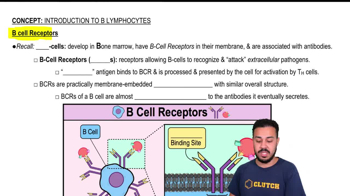
B Cell Receptors
939
views
5
rank
3:55
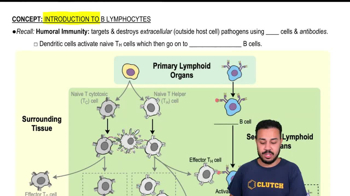
Humoral Immunity
1034
views
10
rank
Terms in this set (15)
Hide definitions
B lymphocytes
Cells crucial for adaptive humoral immunity, targeting extracellular pathogens using antibodies.
Humoral immunity
Part of the adaptive immune system targeting extracellular pathogens with B cells and antibodies.
Antibodies
Proteins secreted by plasma cells that bind to antigens to neutralize or destroy pathogens.
Bone marrow
Primary lymphoid organ where B cells develop and mature before migrating to secondary organs.
B cell receptors
Membrane-embedded receptors on B cells that bind free-floating antigens, also known as BCRs.
Antigen
A substance that is recognized by the immune system and can provoke an immune response.
MHC class II molecules
Molecules on antigen-presenting cells that display processed antigens to helper T cells.
Helper T cells
Cells that assist in activating B cells by recognizing antigens presented on MHC class II molecules.
Plasma cells
Effector B cells that secrete large quantities of antibodies to combat immediate threats.
Memory B cells
Long-lived cells that respond faster to future infections by remembering the antigen.
Cytokines
Signaling proteins released by cells, such as helper T cells, to activate immune responses.
Epitope
Specific part of an antigen that is recognized and bound by an antibody or BCR.
Naive B cells
Inactive B cells that have not yet encountered their specific antigen.
Clones
Identical cells produced from a single B cell after activation and proliferation.
Effector cells
Activated cells that perform a specific immune function, such as plasma cells producing antibodies.
 BackBack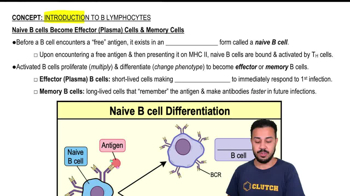
 4:23
4:23