Negative pressure systems occur when the pressure inside a system is lower than the atmospheric pressure outside. This can create a vacuum effect, causing air or fluid to be drawn into the system.
What are true facts regarding atmospheric pressure?
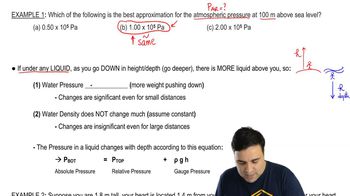
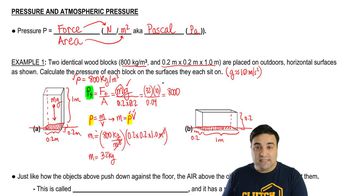
Atmospheric pressure at sea level is approximately 1.01 x 10^5 Pascals. It decreases with altitude due to the decreasing weight of the air above. Atmospheric pressure is also equivalent to 1 ATM or 760 mmHg.
What is the definition of pressure in physics?
Pressure is defined as force divided by area, measured in Pascals (Pa), which is equivalent to Newtons per square meter.
How does atmospheric pressure change with altitude?
Atmospheric pressure decreases with altitude due to the decreasing weight of the air above.
What is the formula to calculate pressure at a certain depth in a liquid?
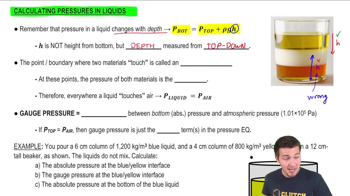
The formula is P_bottom = P_top + (rho)(g)(h), where rho is the density of the liquid, g is the acceleration due to gravity, and h is the depth from the surface.
What is gauge pressure?
Gauge pressure is the difference between absolute pressure and atmospheric pressure, representing the additional pressure in a system relative to atmospheric pressure.
How is the pressure at the bottom of a liquid column calculated?
The pressure at the bottom is calculated using the equation P_bottom = P_top + (rho)(g)(h), where P_top is the pressure at the top of the column.
What is the standard atmospheric pressure at sea level in Pascals?
The standard atmospheric pressure at sea level is approximately 1.01 x 10^5 Pascals.
How does the pressure in a liquid change with depth?
Pressure in a liquid increases with depth because of the increasing weight of the liquid above the point of measurement.
 Back
Back

 17:04
17:04