Skip to main content
Analytical Chemistry
My Course
Learn
Exam Prep
AI Tutor
Study Guides
Flashcards
Explore
Try the app
My Course
Learn
Exam Prep
AI Tutor
Study Guides
Flashcards
Explore
Try the app
Back
Chemical Concentrations definitions
You can tap to flip the card.
Ion
You can tap to flip the card.
👆
Ion
A charged particle present in a solution that influences its physical properties.
Track progress
Control buttons has been changed to "navigation" mode.
1/14
Related flashcards
Related practice
Recommended videos
Chemical Concentrations quiz #1
Chemical Concentrations
10 Terms
Chemical Concentrations quiz
Chemical Concentrations
15 Terms
Chemical Concentrations
1. Chemical Measurements
5 problems
Topic
Volumetric Analysis
1. Chemical Measurements
5 problems
Topic
1. Chemical Measurements - Part 1 of 2
4 topics
12 problems
Chapter
1. Chemical Measurements - Part 2 of 2
1 topic
3 problems
Chapter
Guided course
04:50
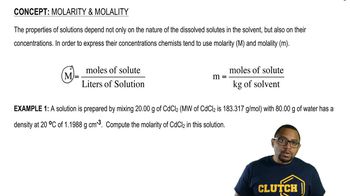
Molarity & Molality 1
566
views
8
rank
Guided course
01:54
Molarity vs. Molality
926
views
7
rank
Guided course
05:46
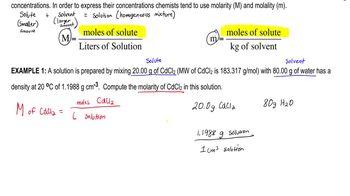
Molarity & Molality
794
views
11
rank
1
comments
Terms in this set (14)
Hide definitions
Ion
A charged particle present in a solution that influences its physical properties.
Colligative Property
A characteristic of solutions dependent on the number of dissolved particles, not their identity.
Molarity
A concentration unit expressing moles of solute per liter of solution, denoted by a capital M.
Molality
A concentration unit expressing moles of solute per kilogram of solvent, useful for temperature-independent calculations.
Solute
The component present in a smaller amount within a solution, dissolved by the solvent.
Solvent
The component present in a larger amount within a solution, responsible for dissolving the solute.
Solution
A homogeneous mixture where the solute is uniformly dispersed within the solvent.
Concentration
A measure of the amount of solute present in a given quantity of solvent or solution.
Homogeneous Mixture
A mixture with uniform composition throughout, where individual components are not distinguishable.
Physical Property
A characteristic of a solution, such as boiling point or freezing point, affected by dissolved particles.
Analytical Chemistry
A branch of chemistry focused on the identification and quantification of substances in a sample.
General Chemistry
An introductory field covering fundamental chemical principles, often revisited in advanced studies.
Unit
A standard quantity used to specify measurements, such as liters, kilograms, or moles in solution calculations.
Mole
A fundamental chemical quantity representing Avogadro's number of particles, used in concentration calculations.
 BackBack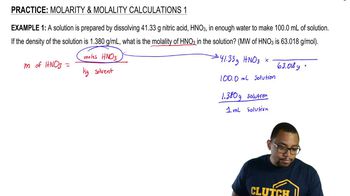
 04:50
04:50