Skip to main content
Analytical Chemistry
My Course
Learn
Exam Prep
AI Tutor
Study Guides
Flashcards
Explore
Try the app
My Course
Learn
Exam Prep
AI Tutor
Study Guides
Flashcards
Explore
Try the app
Back
Diprotic Buffers quiz
You can tap to flip the card.
What is the key difference between monoprotic and diprotic acids?
You can tap to flip the card.
👆
What is the key difference between monoprotic and diprotic acids?
Diprotic acids have two acidic hydrogens and therefore possess two dissociation constants (Ka1 and Ka2), unlike monoprotic acids which have only one.
Track progress
Control buttons has been changed to "navigation" mode.
1/15
Related flashcards
Related practice
Recommended videos
Diprotic Buffers definitions
Diprotic Buffers
15 Terms
Diprotic Buffers
9. Polyprotic Acid-Base Equilibria
5 problems
Topic
Polyprotic Buffers
9. Polyprotic Acid-Base Equilibria
5 problems
Topic
9. Polyprotic Acid-Base Equilibria - Part 1 of 2
4 topics
12 problems
Chapter
9. Polyprotic Acid-Base Equilibria - Part 2 of 2
2 topics
6 problems
Chapter
Guided course
02:45
Monoprotic & Diprotic Buffer Calculations 1
378
views
5
rank
Guided course
06:44
Monoprotic & Diprotic Buffer Calculations 1
377
views
3
rank
2
comments
Guided course
01:51
Diprotic Buffers
540
views
5
rank
Terms in this set (15)
Hide definitions
What is the key difference between monoprotic and diprotic acids?
Diprotic acids have two acidic hydrogens and therefore possess two dissociation constants (Ka1 and Ka2), unlike monoprotic acids which have only one.
How many pKa values does a diprotic acid have?
A diprotic acid has two pKa values, corresponding to the dissociation of each acidic hydrogen.
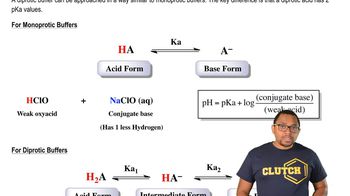
What is the generic formula for a fully protonated diprotic acid?
The generic formula is H2A, where both acidic hydrogens are present.
Which dissociation constant is used when removing the first acidic hydrogen from a diprotic acid?
Ka1 is used when removing the first acidic hydrogen.
What form is produced after removing the first acidic hydrogen from a diprotic acid?
The intermediate form, often written as HA−, is produced after removing the first hydrogen.
Which dissociation constant is used when removing the second acidic hydrogen from a diprotic acid?
Ka2 is used when removing the second acidic hydrogen.
What is the base form of a diprotic acid after both hydrogens are removed?
The base form is A2−, which has no acidic hydrogens remaining.
How does the Henderson-Hasselbalch equation differ for diprotic buffer systems?
It can use either pKa1 or pKa2 depending on whether the calculation involves the acid and intermediate form or the intermediate and base form.
What is the Henderson-Hasselbalch equation for the acid and intermediate forms in a diprotic buffer?
pH = pKa1 + log([intermediate]/[acid])
What is the Henderson-Hasselbalch equation for the intermediate and base forms in a diprotic buffer?
pH = pKa2 + log([base]/[intermediate])
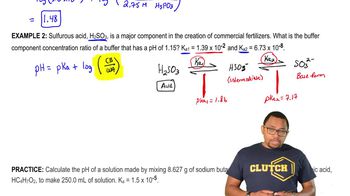
In the example of sulfurous acid (H2SO3), what is the intermediate form after removing the first hydrogen?
The intermediate form is HSO3−, also known as hydrogen sulfite or bisulfite.
What is the base form of sulfurous acid after removing both acidic hydrogens?
The base form is SO3^2−, the sulfite ion.
How do you convert volumes and molarities into moles for buffer calculations?
Multiply the volume in liters by the molarity to obtain the number of moles.
Can you use moles or molarity in the Henderson-Hasselbalch equation for diprotic buffers?
Yes, either moles or molarity can be used as long as the ratio is correct.
Why is it important to choose the correct pKa value and form in diprotic buffer calculations?
Choosing the correct pKa and form ensures accurate pH calculation, as each step of dissociation affects the buffer system differently.
 BackBack
 02:45
02:45