Skip to main content
Analytical Chemistry
My Course
Learn
Exam Prep
AI Tutor
Study Guides
Flashcards
Explore
Try the app
My Course
Learn
Exam Prep
AI Tutor
Study Guides
Flashcards
Explore
Try the app
Back
Gravimetric Analysis quiz
You can tap to flip the card.
What is the main purpose of gravimetric analysis in chemistry?
You can tap to flip the card.
👆
What is the main purpose of gravimetric analysis in chemistry?
Gravimetric analysis is used to determine the amount of an analyte by measuring the mass of a product formed in a chemical reaction.
Track progress
Control buttons has been changed to "navigation" mode.
1/15
Related flashcards
Related practice
Recommended videos
Gravimetric Analysis definitions
Gravimetric Analysis
15 Terms
Gravimetric Analysis
16. Electroanalytical Techniques
5 problems
Topic
Coulometry
16. Electroanalytical Techniques
5 problems
Topic
16. Electroanalytical Techniques
4 topics
12 problems
Chapter
Guided course
03:27
Electrogravimetric Analysis Example 1
434
views
2
rank
1
comments
Guided course
06:11
Electrogravimetric Analysis Calculations Example 2
344
views
2
rank
1
comments
Guided course
04:00
Electrogravimetric Analysis Practice
342
views
3
rank
Terms in this set (15)
Hide definitions
What is the main purpose of gravimetric analysis in chemistry?
Gravimetric analysis is used to determine the amount of an analyte by measuring the mass of a product formed in a chemical reaction.
How is the molarity of an analyte calculated in gravimetric analysis?
Molarity is calculated by dividing the moles of analyte by the volume of the solution in liters.
Why is it important to convert milliliters to liters when calculating molarity?
Molarity is defined as moles per liter, so the solution volume must be in liters for accurate calculation.
What is the first step in determining the molarity of bromide ion from a gravimetric analysis problem?
The first step is to convert the solution volume from milliliters to liters.
How do you determine the moles of bromide ion from the mass of lead(II) bromide precipitate?
You use the mass of lead(II) bromide, its molar mass, and the stoichiometry from the balanced chemical equation to find the moles of bromide ion.
What is the molar mass of lead(II) bromide (PbBr2) used in the example?
The molar mass of lead(II) bromide is approximately 367.008 grams per mole.
What is the stoichiometric relationship between bromide ion and lead(II) bromide in the reaction?
For every 1 mole of lead(II) bromide formed, 2 moles of bromide ion are required.
Why is stoichiometry important in gravimetric analysis?
Stoichiometry allows you to relate the amount of precipitate formed to the amount of analyte present.
How many significant figures should the final answer have in the example provided?
The final answer should have 4 significant figures, matching the precision of the given data.
What is the calculated molarity of bromide ion in the example problem?
The calculated molarity of bromide ion is 0.1646 M.
Why is it necessary to use a balanced chemical equation in gravimetric analysis?
A balanced equation ensures the correct stoichiometric ratios are used to relate reactants and products.
What role does atomic mass play in gravimetric analysis?
Atomic mass is used to calculate the molar mass of compounds, which is essential for converting between grams and moles.
What is the definition of quantitative analysis as exemplified by gravimetric analysis?
Quantitative analysis involves measuring and calculating the amount or concentration of a substance in a sample.
What is the significance of using excess lead(II) sulfate in the precipitation reaction?
Using excess lead(II) sulfate ensures that all bromide ions react and precipitate as lead(II) bromide.
What is the general formula for calculating molarity in gravimetric analysis?
Molarity = moles of analyte / liters of solution.
 BackBack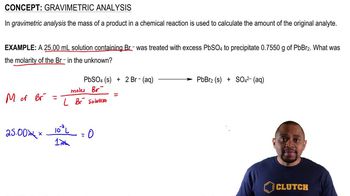
 03:27
03:27