Skip to main content
Analytical Chemistry
My Course
Learn
Exam Prep
AI Tutor
Study Guides
Flashcards
Explore
Try the app
My Course
Learn
Exam Prep
AI Tutor
Study Guides
Flashcards
Explore
Try the app
Back
General Approach to Acid-Base Systems definitions
You can tap to flip the card.
Strong Acid
You can tap to flip the card.
👆
Strong Acid
A substance that fully dissociates in water, yielding a high concentration of H+ ions and exhibiting a Ka value greater than 1.
Track progress
Control buttons has been changed to "navigation" mode.
1/15
Related flashcards
Related practice
Recommended videos
General Approach to Acid-Base Systems quiz
General Approach to Acid-Base Systems
15 Terms
General Approach to Acid-Base Systems
12. Advanced Topics in Equilibrium
5 problems
Topic
Fractional Compositions and Concentrations
12. Advanced Topics in Equilibrium
5 problems
Topic
12. Advanced Topics in Equilibrium
3 topics
9 problems
Chapter
Guided course
02:03
Systematic Approach
330
views
2
rank
Guided course
04:21
Systematic Approach
297
views
1
rank
Guided course
08:53
Systematic Approach Calculations
302
views
1
rank
Terms in this set (15)
Hide definitions
Strong Acid
A substance that fully dissociates in water, yielding a high concentration of H+ ions and exhibiting a Ka value greater than 1.
Strong Base
A compound that completely ionizes in solution, producing a significant amount of OH- ions and characterized by a Kb value greater than 1.
Electrolyte
A substance that conducts electricity in solution due to the presence of freely moving ions formed upon dissolution.
Ionization
The process by which a molecule separates into ions when dissolved, leading to electrical conductivity in the solution.
Ka Value
A quantitative measure of acid strength, indicating the equilibrium constant for the dissociation of an acid in water.
Kb Value
A numerical expression of base strength, representing the equilibrium constant for the dissociation of a base in water.
pH
A logarithmic scale used to specify the acidity of a solution, calculated as the negative log of the H+ ion concentration.
pOH
A logarithmic measure of the basicity of a solution, determined by taking the negative log of the OH- ion concentration.
Autoionization of Water
A self-ionization process where water molecules generate small amounts of H+ and OH- ions, affecting solution pH at low solute concentrations.
Neutral Solution
A state where the concentrations of H+ and OH- ions are equal, resulting in a pH of 7, typically observed when acid or base is very dilute.
Concentration
The amount of solute present in a given volume of solution, crucial for determining the calculation method for pH or pOH.
Negative Logarithm
A mathematical operation used to convert ion concentrations into pH or pOH values, simplifying the comparison of acidity or basicity.
Hydronium Ion
The H+ ion in aqueous solution, responsible for acidic properties and central to pH calculations.
Hydroxide Ion
The OH- ion in solution, responsible for basic properties and essential for determining pOH.
Systematic Approach
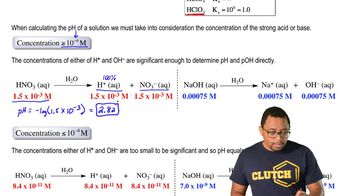
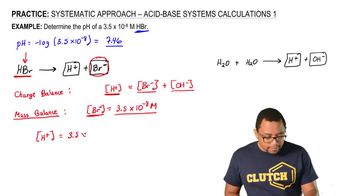
A stepwise method for calculating pH or pOH, especially necessary when acid or base concentrations are between 10^-6 M and 10^-8 M.
 BackBack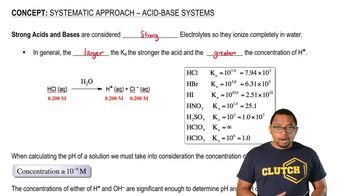
 02:03
02:03