Skip to main content
Analytical Chemistry
My Course
Learn
Exam Prep
AI Tutor
Study Guides
Flashcards
Explore
Try the app
My Course
Learn
Exam Prep
AI Tutor
Study Guides
Flashcards
Explore
Try the app
Back
Metal Chelate Complexes quiz
You can tap to flip the card.
What is a ligand in the context of metal chelate complexes?
You can tap to flip the card.
👆
What is a ligand in the context of metal chelate complexes?
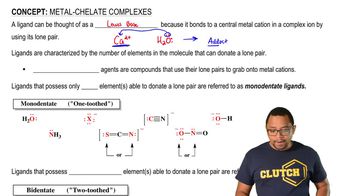
A ligand is a Lewis base that donates a lone pair of electrons to a metal cation (Lewis acid) to form a complex ion.
Track progress
Control buttons has been changed to "navigation" mode.
1/15
Related flashcards
Related practice
Recommended videos
Metal Chelate Complexes definitions
Metal Chelate Complexes
15 Terms
Metal Chelate Complexes
11. EDTA Titrations
5 problems
Topic
EDTA
11. EDTA Titrations
5 problems
Topic
11. EDTA Titrations
3 topics
9 problems
Chapter
Guided course
03:21
Metal Chelate Complexes
377
views
7
rank
1
comments
Guided course
04:05
Metal Chelate Complexes
576
views
7
rank
Guided course
04:09
Metal Chelate Complexes
406
views
7
rank
Terms in this set (15)
Hide definitions
What is a ligand in the context of metal chelate complexes?
A ligand is a Lewis base that donates a lone pair of electrons to a metal cation (Lewis acid) to form a complex ion.
What is the product called when a ligand and a metal ion combine?
The product is called an adduct, which is a complex ion formed by the addition of a ligand to a metal ion.
How many connections do metal ions typically form with ligands in a complex?
Metal ions typically form six connections (bonds) with ligands in a complex.
What is a monodentate ligand?
A monodentate ligand is a ligand that has only one atom capable of donating a lone pair to a metal ion.
Give two examples of monodentate ligands.
Examples include water (H2O) and ammonia (NH3).
What is a bidentate ligand?
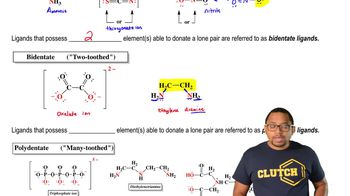
A bidentate ligand has two atoms that can each donate a lone pair to a metal ion, allowing it to form two bonds with the metal.
Name two common bidentate ligands.
Oxalate ion and ethylenediamine are common bidentate ligands.
Why do bidentate and polydentate ligands form more stable complexes than monodentate ligands?
They form cyclic structures with the metal ion, which increases the stability of the complex; this is known as the chelate effect.
What is the chelate effect?
The chelate effect is the increased stability of complexes formed by bidentate and polydentate ligands due to the formation of cyclic structures.
What does 'polydentate ligand' mean?
A polydentate ligand has more than two atoms capable of donating lone pairs to a metal ion, allowing it to form multiple bonds.
Give an example of a common polydentate ligand.
EDTA (Ethylenediaminetetraacetate ion) is a common polydentate ligand.
What is the typical ligand-to-metal ratio for most chelating agents?
The typical ligand-to-metal ratio is 1:1 for most chelating agents.
Which ligand is an exception to the typical 1:1 ligand-to-metal ratio, and what is its ratio?
NTA (nitrilotriacetic acid) is the exception, with a 2:1 ligand-to-metal ratio.
Why can't monodentate ligands form cyclic structures with metal ions?
Monodentate ligands have only one donor atom, so they cannot form the multiple bonds needed to create a cyclic structure.
What is the role of lone pairs in the formation of metal chelate complexes?
Lone pairs from the ligand are donated to the metal ion, forming coordinate covalent bonds that create the complex.
 BackBack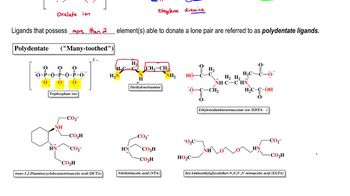
 03:21
03:21