Skip to main content
Analytical Chemistry
My Course
Learn
Exam Prep
AI Tutor
Study Guides
Flashcards
Explore
Try the app
My Course
Learn
Exam Prep
AI Tutor
Study Guides
Flashcards
Explore
Try the app
Back
Polyprotic Acids and Bases quiz
You can tap to flip the card.
What are the equilibrium constants called for each stage of deprotonation in a polyprotic acid?
You can tap to flip the card.
👆
What are the equilibrium constants called for each stage of deprotonation in a polyprotic acid?
They are called Ka1, Ka2, and Ka3 for the first, second, and third deprotonations, respectively.
Track progress
Control buttons has been changed to "navigation" mode.
1/15
Related flashcards
Related practice
Recommended videos
Polyprotic Acids and Bases definitions
Polyprotic Acids and Bases
14 Terms
Polyprotic Acids and Bases
9. Polyprotic Acid-Base Equilibria
5 problems
Topic
Diprotic Buffers
9. Polyprotic Acid-Base Equilibria
5 problems
Topic
9. Polyprotic Acid-Base Equilibria - Part 1 of 2
4 topics
12 problems
Chapter
9. Polyprotic Acid-Base Equilibria - Part 2 of 2
2 topics
6 problems
Chapter
Guided course
02:20
Polyprotic Bases
529
views
4
rank
Guided course
02:30
Polyprotic Acids
553
views
6
rank
Guided course
15:57
Polyprotic Acid Calculations
434
views
3
rank
2
comments
Terms in this set (15)
Hide definitions
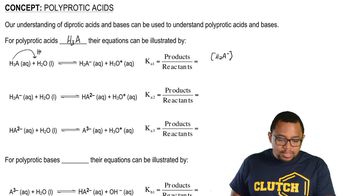
What are the equilibrium constants called for each stage of deprotonation in a polyprotic acid?
They are called Ka1, Ka2, and Ka3 for the first, second, and third deprotonations, respectively.
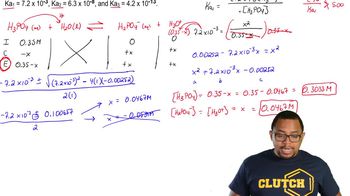
How do you treat a fully protonated polyprotic acid (e.g., H3A) when calculating [H+]?
Treat it as a monoprotic acid and use Ka1 to determine the H+ concentration.
Which equilibrium constant do you use for the fully deprotonated base form (e.g., A3-) of a polyprotic acid?
Use Kb1 for calculations involving the fully deprotonated base form.
What is the relationship between Ka1 and Kb3 in a polyprotic system?
Ka1 multiplied by Kb3 equals Kw (Ka1 × Kb3 = Kw).
How do you calculate [H+] for the first intermediate form of a triprotic acid?
Use the formula: (Ka1 × Ka2 × initial concentration + Ka1 × Kw) / (Ka1 + initial concentration).
What formula is used to find [H+] for the second intermediate of a triprotic acid?
Use (Ka2 × Ka3 × initial concentration + Ka2 × Kw) / (Ka2 + initial concentration).
How many possible forms exist for a triprotic acid in solution?
There are four forms: the fully acid form, the fully basic form, and two intermediate forms.
What calculation method is used for the fully acid or fully base forms of a polyprotic species?
Set up an ICE chart and use Ka1 for the acid form or Kb1 for the base form.
What does it mean when equilibrium constants 'overlap' in polyprotic systems?
It means that certain Ka and Kb values are related such that their product equals Kw, reflecting the reversible nature of proton transfer.
What is the relationship between Ka2 and Kb2 in polyprotic acids and bases?
Ka2 multiplied by Kb2 equals Kw (Ka2 × Kb2 = Kw).
What is the relationship between Ka3 and Kb1 in polyprotic systems?
Ka3 multiplied by Kb1 equals Kw (Ka3 × Kb1 = Kw).
How do you approach calculating [H+] for intermediate forms of polyprotic acids?
Use specific formulas that combine Ka and Kw values, rather than ICE charts.
What does Kw represent in the context of polyprotic acids and bases?
Kw is the ion product of water, equal to 1.0 × 10^-14 at 25°C, and relates acid and base dissociation constants.
When adding protons to a fully deprotonated polyprotic base, which constants are used?
Use Kb1 for the first proton addition, Kb2 for the second, and Kb3 for the third.
Why are intermediate forms of polyprotic acids considered easier to calculate?
Because you can directly apply the provided formulas to find [H+], rather than setting up an ICE chart.
 BackBack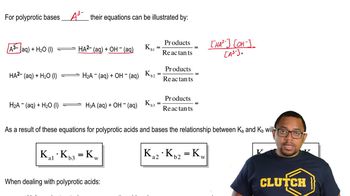
 02:20
02:20