Back

Hypothesis Testing (t-Test) quiz

Control buttons has been changed to "navigation" mode.
1/15
  • What is the primary purpose of the t-test in analytical chemistry?

    The t-test is used to compare the means of populations, especially when the population standard deviation is unknown and the sample size is less than 30.
  • When should you use the t-test instead of the z-test?

    The t-test is used when the sample size is less than 30 and the population standard deviation is unknown.
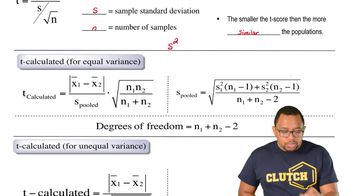
  • What is the formula for the t score in a single population?

    The t score formula is t = (sample average - Mu_0) / (s / sqrt(n)), where s is the sample standard deviation and n is the number of measurements.
  • What does a larger t score indicate about two populations?

    A larger t score indicates that the populations are more different from each other.
  • What does a smaller t score suggest about the populations being compared?

    A smaller t score suggests that the populations are more similar to each other.
  • What are the three variations of the t-test used for comparing two populations?

    The three variations are t-test for equal variances, t-test for unequal variances, and paired t-test.
  • How is variance related to standard deviation in t-test calculations?

    Variance is the square of the standard deviation.
  • What is the formula for t calculated when variances are equal between two populations?

    t calculated = |average of population 1 - average of population 2| / (s pooled × sqrt(measurements multiplied/divided by measurements added)).
  • What is s pooled and how is it calculated?

    s pooled is the pooled standard deviation, calculated using the standard deviations and sample sizes of both populations.
  • How do you determine which t-test formula to use when comparing two populations?

    You determine if the variances between the two populations are equal or not; use the equal variance formula if they are, and the unequal variance formula if they are not.
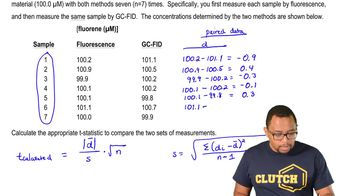
  • What is the paired t-test used for?

    The paired t-test is used when comparing two methods or conditions that are significantly different, such as using different analytical techniques.
  • How are degrees of freedom calculated for unequal variances in t-tests?

    Degrees of freedom for unequal variances require a more complex formula involving the standard deviations and sample sizes of both populations.
  • What is the significance of comparing t calculated to t table values?

    If t calculated is greater than t table, there is a significant difference between the means; if it is less, there is no significant difference.
  • What type of data requires the use of a paired t-test?

    Paired t-test is used when the data comes from two populations analyzed by completely different methods.
  • Why is it important to refer to a formula sheet or professor when performing t-test calculations?

    T-test formulas can be complex, especially for unequal variances, so it's best to use a formula sheet or consult your professor to ensure accuracy.