Pearson+ LogoPearson+ Logo

Volumetric Titrations quiz #1 Flashcards

Back
Volumetric Titrations quiz #1
Control buttons has been changed to "navigation" mode.
1/13
  • What is standardization in the context of volumetric titrations, and what type of solution is typically standardized?

    Standardization is the process of titrating a solution prepared from a reagent of unknown or approximate concentration in order to accurately determine its concentration. This is typically done using a primary standard solution.
  • In a titration, what is the analyte and what role does it play in the process?

    The analyte in a titration is the substance whose concentration is being determined. It reacts with a titrant of known concentration according to a balanced chemical equation.
  • What is the main purpose of standardization in analytical chemistry?

    The main purpose of standardization in analytical chemistry is to accurately determine the concentration of a solution, ensuring precise and reliable results in subsequent titrations and stoichiometric calculations.
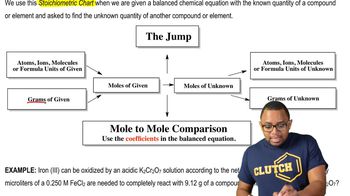
  • What is the purpose of a stoichiometric chart in titration calculations?

    A stoichiometric chart helps organize given and unknown quantities based on a balanced chemical equation. It guides the conversion between different units and compounds during titration calculations.
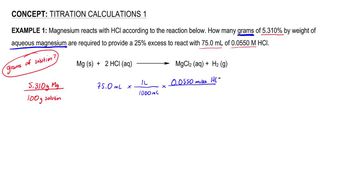
  • How do you convert a given mass of a compound to moles during titration calculations?

    To convert mass to moles, divide the given mass by the molecular weight of the compound. This allows you to use the amount in stoichiometric calculations.
  • What is Avogadro's number and when is it used in titration calculations?

    Avogadro's number is 6.022 × 10^23 and is used to convert between moles and the number of atoms, ions, molecules, or formula units. It is essential when the given or unknown quantity is in terms of particles rather than moles.
  • How do the coefficients in a balanced chemical equation affect titration calculations?

    The coefficients indicate the mole-to-mole ratios between reactants and products. These ratios are used to relate the amount of one substance to another during titration.
  • What is the difference between atoms, ions, molecules, and formula units in stoichiometric calculations?

    Atoms refer to neutral single elements, ions are charged single elements, molecules are covalent compounds, and formula units are ionic compounds. Each term is used depending on the chemical species involved in the calculation.
  • Why is a balanced chemical equation necessary for titration and stoichiometric calculations?

    A balanced equation provides the correct stoichiometric relationships between reactants and products. Without it, you cannot accurately determine the quantities involved in the reaction.
  • What is meant by 'the jump' in the context of stoichiometric titration calculations?

    The 'jump' refers to moving from the side of the stoichiometric chart with known information to the side with the unknown quantity. This process requires a mole-to-mole comparison using the balanced equation.
  • What is standardization in the context of volumetric titrations, and what type of solution is typically titrated during this process?

    Standardization is the process of determining the exact concentration of a solution, typically by titrating a solution prepared from a reagent of approximate concentration (often called a primary or secondary standard) against a solution of known concentration.
  • In a titration, what is the analyte and what role does it play in the process?

    The analyte in a titration is the substance whose concentration is being determined. It reacts with a titrant of known concentration according to a balanced chemical equation.
  • What is the main purpose of standardization in analytical chemistry?

    The main purpose of standardization in analytical chemistry is to accurately determine the concentration of a solution so it can be reliably used in quantitative analyses such as titrations.