Back
BackAnalytical Chemistry Study Guidance: Acids, Bases, Equilibria, and Buffers
Study Guide - Smart Notes
 Tailored notes based on your materials, expanded with key definitions, examples, and context.
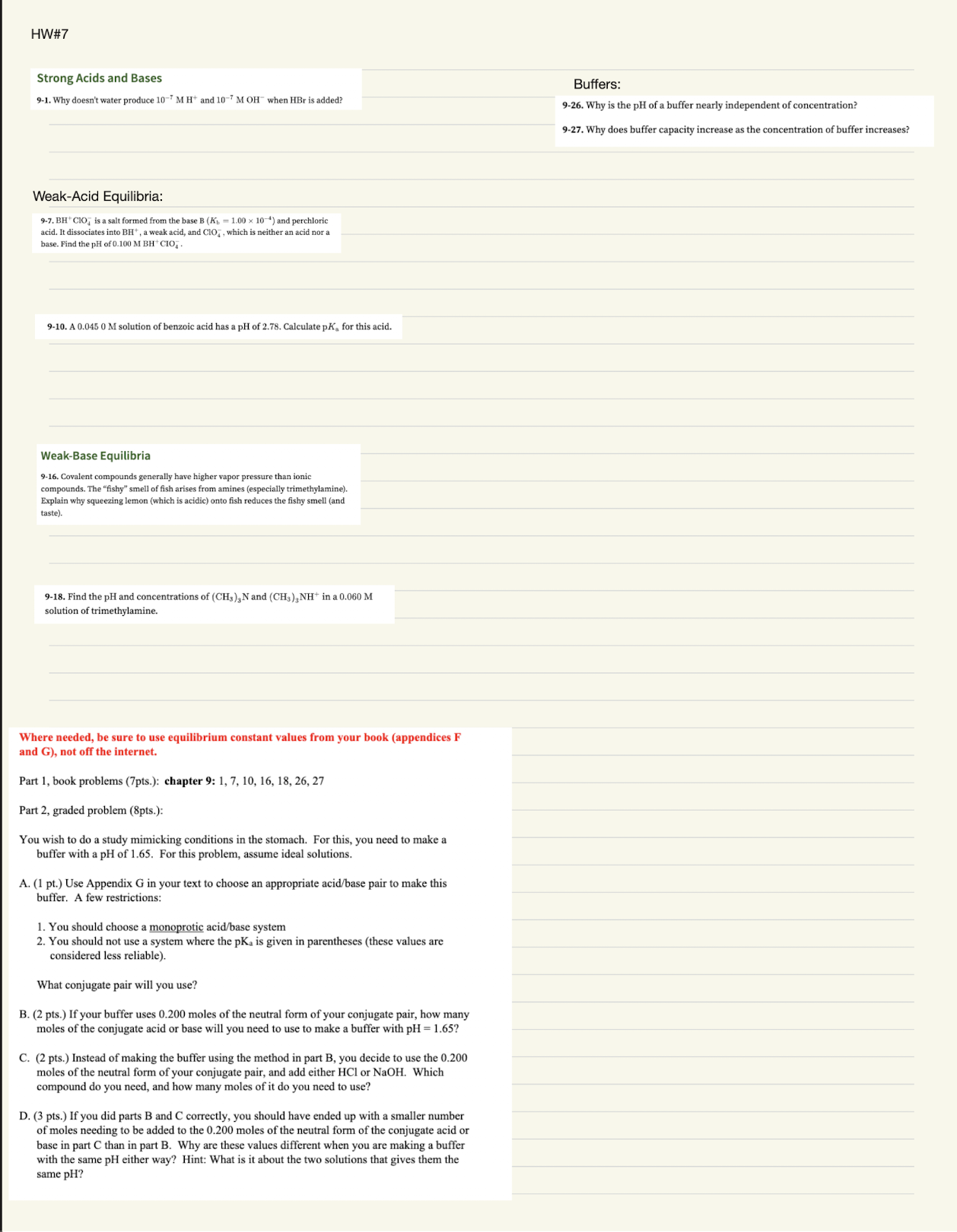
Q1. Why doesn't water produce M and $10^{-7}$ M when HBr is added?
Background
Topic: Strong Acids and Water Equilibrium
This question tests your understanding of how strong acids affect the equilibrium of water and the concentrations of and ions.
Key Terms and Formulas:
: The ionization constant of water, at 25°C.
Strong acid: Completely dissociates in water, increasing .
Step-by-Step Guidance
Recall that pure water at 25°C has M due to autoionization.
When HBr (a strong acid) is added, it dissociates completely, greatly increasing .
Consider how the increased affects the equilibrium: must still be satisfied, so decreases as $[H^+]$ increases.
Set up the relationship: .
Try solving on your own before revealing the answer!
Q2. BH ClO is a salt formed from the base B () and perchloric acid. It dissociates into BH$^+$, a weak acid, and ClO$_4^-$, which is neither an acid nor a base. Find the pH of 0.100 M BH$^+$ ClO$_4^-$.
Background
Topic: Weak Acid Equilibria
This question tests your ability to calculate the pH of a solution containing a weak acid formed from a salt.
Key Terms and Formulas:
: Base dissociation constant
: Acid dissociation constant, related to by
pH:
Step-by-Step Guidance
Calculate for BH using .
Write the dissociation equation for BH: .
Set up the ICE table for the dissociation of BH in water.
Write the expression for and set up the equation to solve for .
Try solving on your own before revealing the answer!
Q3. A 0.0450 M solution of benzoic acid has a pH of 2.78. Calculate p for this acid.
Background
Topic: Weak Acid Equilibria
This question tests your ability to determine the acid dissociation constant () and its logarithmic form (p$K_a$) from pH and concentration data.
Key Terms and Formulas:
: Acid dissociation constant
p:
pH:
Step-by-Step Guidance
Use the pH to find : .
Set up the equilibrium expression for benzoic acid dissociation: .
Assume initial concentration and use the ICE table to find equilibrium concentrations.
Write the expression and solve for $K_a$ using the equilibrium concentrations.
Try solving on your own before revealing the answer!
Q4. Covalent compounds generally have higher vapor pressure than ionic compounds. The “fishy” smell of fish arises from amines (especially trimethylamine). Explain why squeezing lemon (which is acidic) onto fish reduces the fishy smell (and taste).
Background
Topic: Weak-Base Equilibria and Acid-Base Reactions
This question tests your understanding of how acids react with bases (amines) and how this affects their volatility and odor.
Key Terms:
Amines: Weak bases, often volatile and responsible for fishy odors.
Acid-base reaction: Amines react with acids to form non-volatile ammonium salts.
Step-by-Step Guidance
Recall that amines are weak bases and are often volatile, contributing to odor.
When an acid (like lemon juice) is added, it reacts with the amine to form an ammonium salt.
Ammonium salts are ionic and non-volatile, so they do not evaporate and produce odor.
Consider how this chemical change reduces both the smell and taste associated with amines.
Try solving on your own before revealing the answer!
Q5. Find the pH and concentrations of (CH)$_3$N and (CH$_3$)$_3$NH in a 0.060 M solution of trimethylamine.
Background
Topic: Weak-Base Equilibria
This question tests your ability to calculate the pH and equilibrium concentrations in a solution of a weak base.
Key Terms and Formulas:
: Base dissociation constant for trimethylamine
ICE table: Used to track changes in concentration during equilibrium
pH:
Step-by-Step Guidance
Write the dissociation equation: .
Set up the ICE table for the initial concentration and changes at equilibrium.
Write the expression and solve for .
Calculate pOH and then pH.
Try solving on your own before revealing the answer!
Q6. Why is the pH of a buffer nearly independent of concentration?
Background
Topic: Buffers
This question tests your understanding of how buffer solutions maintain pH and why their pH is not strongly affected by changes in concentration.
Key Terms and Formulas:
Buffer: A solution of a weak acid and its conjugate base (or weak base and its conjugate acid).
Henderson-Hasselbalch equation:
Step-by-Step Guidance
Recall the Henderson-Hasselbalch equation and how it relates pH to the ratio of conjugate base to acid.
Notice that the equation depends on the ratio, not the absolute concentrations.
Consider what happens if both concentrations are increased or decreased proportionally.
Try solving on your own before revealing the answer!
Q7. Why does buffer capacity increase as the concentration of buffer increases?
Background
Topic: Buffers
This question tests your understanding of buffer capacity and how it relates to the concentration of buffer components.
Key Terms:
Buffer capacity: The amount of acid or base a buffer can neutralize before pH changes significantly.
Concentration: Higher concentrations mean more moles of acid/base available for neutralization.
Step-by-Step Guidance
Recall that buffer capacity depends on the total amount of acid and base present.
Consider how increasing concentration increases the number of moles available to react with added acid or base.
Think about how this allows the buffer to resist pH changes more effectively.
Try solving on your own before revealing the answer!
Q8. Buffer Preparation: You wish to do a study mimicking conditions in the stomach. For this, you need to make a buffer with a pH of 1.65. For this problem, assume ideal solutions.
Background
Topic: Buffer Preparation and Acid/Base Equilibria
This multi-part question tests your ability to select an appropriate acid/base pair, calculate required moles for buffer preparation, and understand the chemistry behind buffer formation.
Key Terms and Formulas:
Monoprotic acid/base: Acid or base that donates/accepts one proton.
Henderson-Hasselbalch equation:
Conjugate acid/base pair: Related by the gain/loss of a proton.
Step-by-Step Guidance
Part A: Use Appendix G to select a monoprotic acid/base pair with a p close to 1.65 (not in parentheses).
Part B: Use the Henderson-Hasselbalch equation to calculate the ratio of conjugate base to acid needed for pH = 1.65.
Part C: Decide whether to add HCl or NaOH to adjust the ratio, and calculate the moles required.
Part D: Compare the moles needed in parts B and C, and explain why the values differ based on the chemistry of buffer formation.
Try solving on your own before revealing the answer!