Back

Action Potentials quiz

Control buttons has been changed to "navigation" mode.
1/15
  • What is the resting membrane potential of a neuron before an action potential begins?

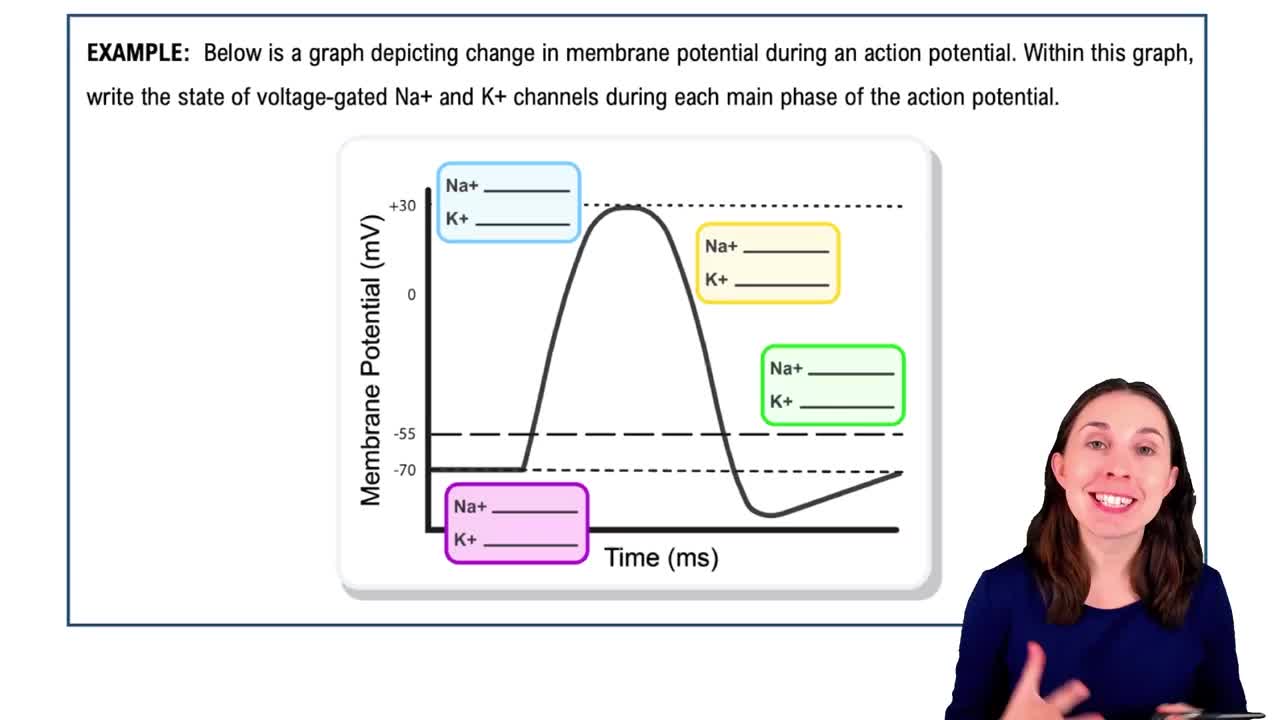
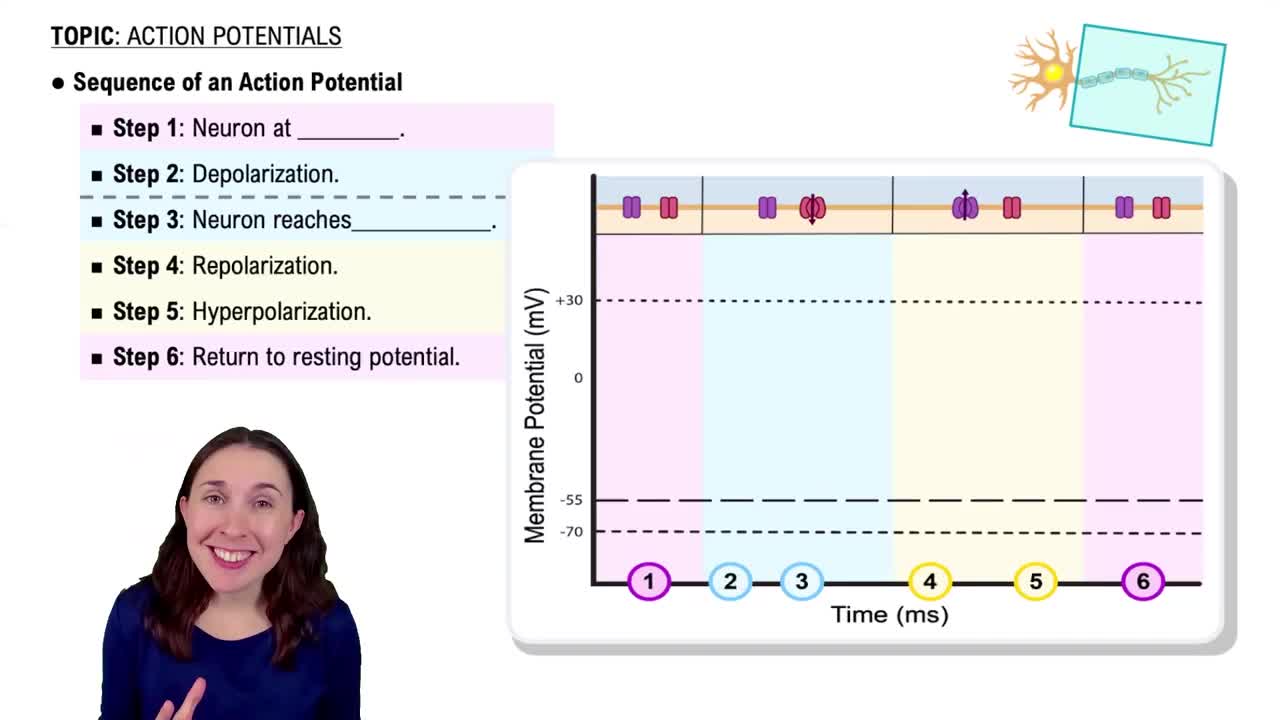
    The resting membrane potential is -70 millivolts.
  • What triggers the opening of voltage-gated sodium channels during an action potential?

    Voltage-gated sodium channels open when the membrane potential reaches the threshold of -55 millivolts.
  • What happens to sodium ions when voltage-gated sodium channels open?

    Sodium ions rush into the neuron following their electrochemical gradient, causing depolarization.
  • To what value does the membrane potential rise during massive depolarization?

    The membrane potential rises to about +30 millivolts.
  • What occurs at +30 millivolts in the action potential sequence?

    Voltage-gated sodium channels close and voltage-gated potassium channels open.
  • What is the effect of opening voltage-gated potassium channels?

    Potassium ions exit the cell, leading to repolarization as the membrane potential becomes more negative.
  • What is repolarization in the context of an action potential?

    Repolarization is the process of returning the membrane potential toward its resting value after depolarization.
  • What is hyperpolarization and when does it occur during an action potential?

    Hyperpolarization occurs when the membrane potential becomes more negative than the resting potential, typically reaching -80 to -90 millivolts.
  • At what membrane potential do voltage-gated potassium channels begin to close?

    Voltage-gated potassium channels begin to close around -50 millivolts.
  • Why does the neuron overshoot its resting potential during repolarization?

    The neuron overshoots because potassium channels close slowly, allowing extra potassium to leave the cell.
  • What restores the neuron to its resting potential after an action potential?

    The sodium-potassium pump restores the neuron to its resting potential.
  • What is the role of EPSPs in initiating an action potential?

    EPSPs depolarize the membrane, helping it reach the threshold needed to trigger an action potential.
  • What is the sequence of channel activity during an action potential?

    First, sodium channels open and then close; next, potassium channels open and then slowly close.
  • What happens to the membrane potential when potassium leaves the cell?

    The membrane potential becomes more negative, leading to repolarization and hyperpolarization.
  • What is the final step in the action potential cycle?

    The sodium-potassium pump restores the membrane potential to -70 millivolts, completing the cycle.